Picking the right lights for your factory, store, or warehouse isn’t just buying something—this call really matters. It impacts how safe the workplace is, how much your team gets done, and your bottom line. Those old metal halide lights? Total energy guzzlers, and their maintenance costs blow up. LED High Bay Lights, though, have become the modern go-to—they beat the old tech flat out when it comes to saving energy and holding up well .
But here’s the deal: not all high bay lights are made equal. With so many choice floating around, how do you avoid wasting cash on one that doesn’t fit? This ultimate guide cuts through the jargon, walking you through the key stuff you need to learn. That way, you can make a decision—get the performance you need and the most value for your money.
Before examining product specifications, begin with a thorough assessment of your facility. The physical characteristics of your space determine fundamental lighting requirements:
Type of Space & Ceiling Height: Is this for a manufacturing facility, a distribution warehouse, a gymnasium, a retail superstore, or an aircraft hangar?High Bay Lights are typically designed for ceilings ranging from 15 feet (4.5m) to over 40 feet (12m) The height directly influences the required light output and beam angle.. For versatile coverage across different heights, GS Light’s UFO series—like the U7, U8, and U10—offer power options from 60W to 320W and beam angles of 60°, 90°, or 120°, while linear models such as the L2 and L4 excel in large open spaces with uniform illumination. For super-high ceilings (over 30ft), the U7 320W or U10 240W with narrow 60° beams deliver focused, long-reaching light.
Primary Tasks: What activities occur below? Precision assembly requires bright, shadow-free light with excellent color rendering. Storage aisles need light directed onto vertical rack faces. Sports venues require wide, uniform illumination to minimize glare for players and spectators. For precision work, the U14 series (with CRI >80, optional >90) and U7 Pro (CRI >80) use premium Philips/Osram LEDs to ensure accurate color perception. Warehouse aisles benefit from the L4 linear series’ asymmetric optics (30×100°/70×105° beam angles), which direct light onto rack faces without wasting energy on aisles. Sports facilities and gyms thrive with the U8 or U12 UFO lights—their 120° wide beams and UGR <19 glare-free design keep spaces evenly lit and comfortable.
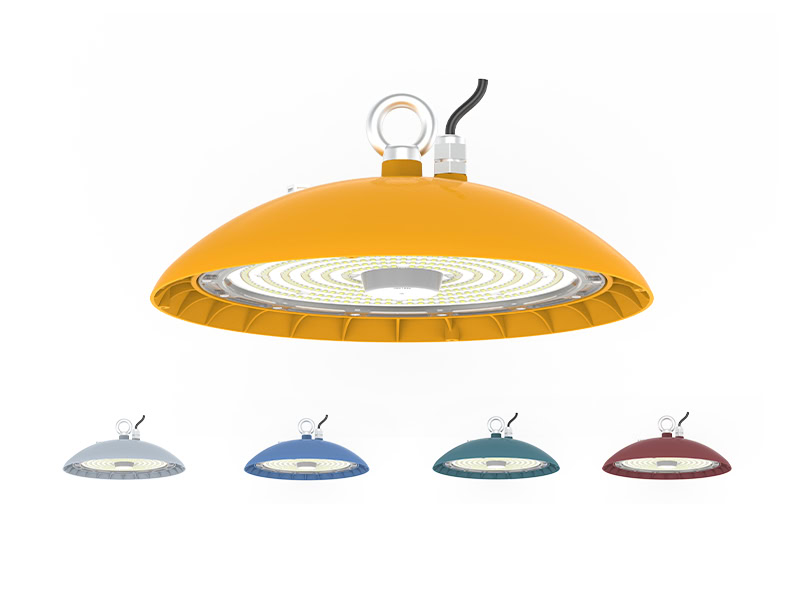
Environmental Conditions: Is the area dusty, humid, or exposed to moisture? Are there corrosive chemicals or significant vibration? These factors determine the necessary IP and IK ratings. Hazardous locations require specifically certified Explosion-Proof High Bay Lights. Most GS Light models come with IP65 protection (dustproof and waterproof), while the L2 and L4 linear series boast IP66 for harsher conditions. The U14 food-grade series even offers IP69K for high-pressure washdowns in food processing plants. For vibration resistance, the U6 and U15’s ADC12 die-cast aluminum bodies and IK08/IK10 ratings stand up to industrial wear and tear.

Break Down the Key Tech Specs (No Jargon—Promise!)
You don’t need to be a tech whiz to compare LED High Bay fixtures—just wrap your head around these no-nonsense metrics that actually affect your space:
Here’s the real-world rule: If your ceilings are tall (think 20+ ft) or you need super bright work areas, you need more lumens. Watts? They’re a relic—old incandescent bulbs used watts to measure brightness, but LEDs are way more efficient. A 100W LED can be brighter than a 400W metal halide, so ignore watts—lumens are the truth.
Pick the beam pattern that fits your space—why light up the walls or ceiling when you need light on the floor?
For typical warehouses, distribution centers, and manufacturing facilities, IP65-rated fixtures generally provide adequate protection against dust accumulation and occasional washdowns. IK08 or IK10 impact ratings ensure resilience against accidental bumps from equipment or inventory.
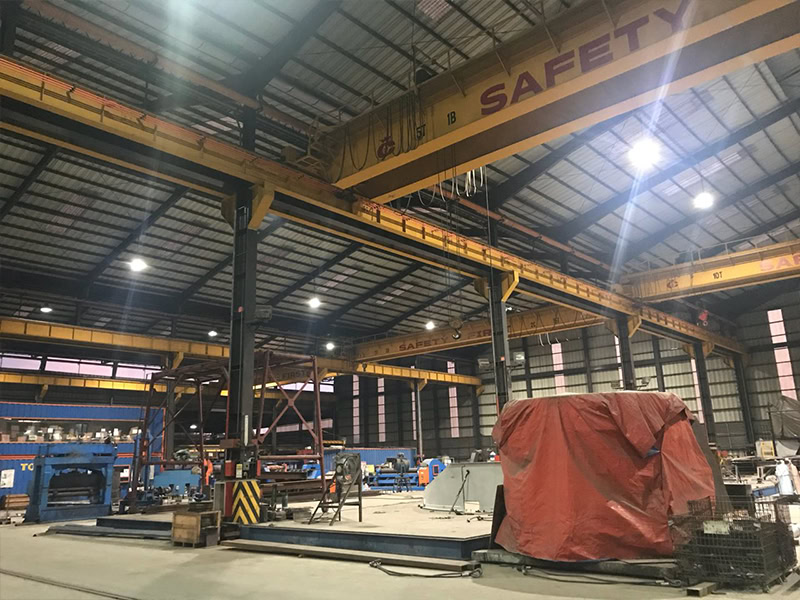
Certain industrial processes crank out serious ambient heat—enough to really tank LED performance and cut their lifespan short. Take places like steel mills, foundries, glass plants, or commercial kitchens: standard LED high bays here often hit snags like these:
Faster Lumen Fade: When LEDs run above their recommended junction temp (usually 105°C), their light output drops way faster than it should.
Driver Burnout: The electronic driver—hands down the most heat-sensitive component—tends to conk out early if it’s stuck in constant high ambient heat.
Color Shift: High temps can throw off the LED’s chromaticity coordinates, making the light look different than intended—definitely not ideal for industrial work.
For these tough, high-heat jobs, you need specialized high-temperature LED high bays built to handle ambient temps up to 90°C (194°F). These purpose-made fixtures pack in key features:
Screw-in Breather Nut Design: Through a specially designed breathable structure, Balance the air pressure inside and outside the lamps

Beefed-Up Heat Management: Oversized, finned heat sinks with optimized surface area—some even add active cooling for super extreme environments (we’ve seen it work wonders in steel mill casting areas!).
Drivers And Dimmable Ways For Option:Choose a well-known power supply like MOSO,Sosen,Philips brand. It features highly stable current output characteristics and can effectively prevent damage to lamps caused by current fluctuations. Supports 0-10V and DALI dimming modes. It can automatically adjust according to natural light and human activities to realize precise lighting and energy conservation
Proven Performance Data: Look for fixtures with LM-80 test results from higher case temps (like Tc = 105°C instead of the standard 55°C)—this tells you they’re actually built to hold up in real-world industrial heat, not just lab conditions.
Modern high bay lights aren’t rigid—they’ve got mounting options that work with whatever your space throws at you:
Easily Sensors Installation (LED High Bay Light – U12 series)

Consider the factor of maintenance requirements during the selection process:
Modular Design: Fixtures with components (drivers, LED modules, optics) extend service life and simplify repairs.
Tool-Free Access: Hinged or removable diffusers/lenses easy to clean and inspection without specialized tools or significant downtime.
Group Replacement Strategy: Despite 50,000+ hour lifespans, planning for eventual replacement ensures consistent light levels. Some facilities adopt a group replacement approach after 60,000-70,000 hours of operation to maintain uniform lighting quality.
Critical Certifications:
Energy Efficiency: DLC Qualified products are often required for utility company rebates, drastically improving ROI.
Others: CE, RoHS, and ISO 9001 manufacturing standards.
A comprehensive TCO analysis includes:
Calculate your annual electricity use with this straightforward formula: (Fixture wattage × hours used per day × days used per year) ÷ 1,000. Compare that number to your current lighting to see how much you could save on power.
Maintenance Expenses
For old-school lighting, this means money spent on replacing bulbs, paying workers to swap out multiple lamps at once, and keeping fixtures clean. LED systems slash these costs by 90% or more—no question.
Utility Rebates
Lots of power companies offer solid rebates when you install DLC-qualified LED lights. These can knock 20-40% off your total project cost, which is a big win.
Productivity Gains
You can’t pin an exact dollar amount on this, but studies back it up: good lighting cuts mistakes by 30-60% and makes teams 2-15% more productive. Those improvements add up to real money for your business.
Sub-zero environments present unique challenges. Specially designed cold storage LED high bays feature:
Class I, Division 2 or Class II, Division 2 locations require appropriately certified fixtures that prevent ignition of flammable gases, vapors, or combustible dusts.
These environments demand fixtures with:

For large facilities, consider a phased implementation:
Post-installation verification ensures the system performs as designed:
A: Yes—most modern models support dimming (0–10V or DALI) and work with motion sensors, daylight harvesting systems, or IoT platforms. This helps reduce energy use further by adjusting light output base occupancy or natural light.
A: Requires minimal maintenance . Different with metal halide lights (which need frequent bulb replacements), LEDs only require occasional cleaning of lenses/heat sinks. Modular designs (replaceable drivers/LED modules) also simplify repairs if needed.
We offer a comprehensive range of LED High Bay Lights designed for different industrial and commercial settings:
Our LED high bay lights are rated to last 50,000 hours . We also back these lights with a 5-year warranty, covering any issues from materials or craftsmanship. It takes the stress out of your purchase, and it’ll save you money on overall costs in the long run too.
Choosing the right LED industrial lighting system isn’t hard—but it does call for balancing technical specs, workplace conditions, cost budgets, and real operational needs. Follow this simple process: evaluate your site, grasp technical details, consider the characteristics of workplace, and tally up all costs. Do that, and you’ll land fixtures with top-tier illumination, peak energy efficiency, and long-lasting durability.
The key takeaway? The priciest options aren’t always the best fit, and the cheapest ones? They’re guaranteed to lose performance or durability over time. Focus on real value instead—opt for products that combine quality, performance, energy efficiency, and sturdiness to keep total costs low throughout the fixtures’ lifespan
Ready to transform your facility’s lighting? Contact our lighting specialists today for a complimentary photometric analysis and energy savings projection tailored to your specific application. Request a sample fixture to evaluate performance in your environment, or download our comprehensive High Bay Lighting Specification Guide for detailed technical information and selection criteria.
We’ve partnered with professional freight forwarders to offer safe and efficient global logistics. With customized packaging, flexible shipping options, and transparent tracking plus customs support, your procurement and delivery are hassle-free.