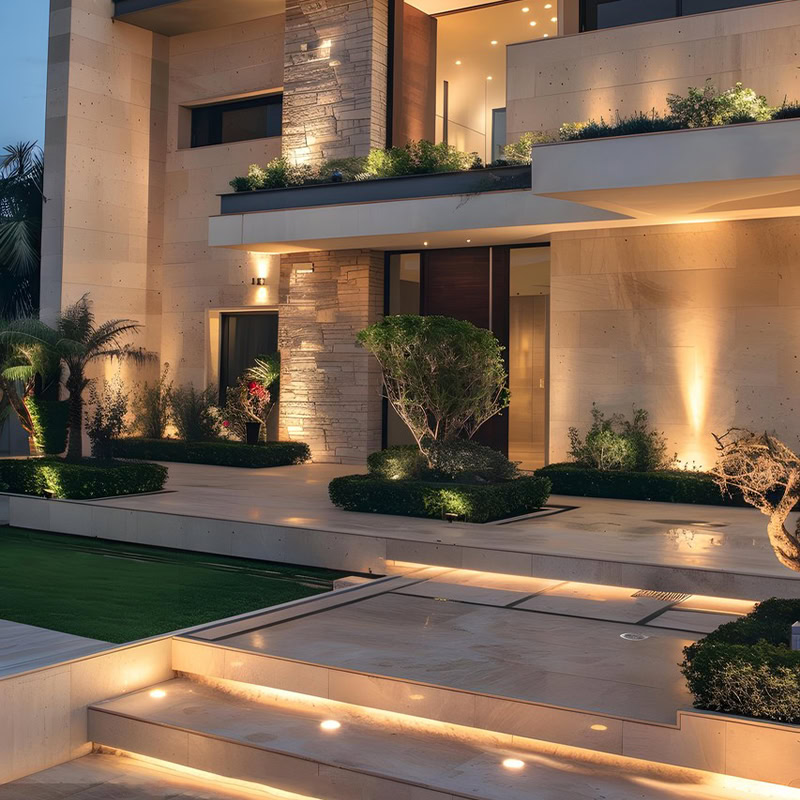
Besoins fondamentaux: Ambiance accueillante pour les invités, guidage sur un chemin sûr, mettre en valeur les points focaux décoratifs.
Lumières enracinées: Le corps principal de la lampe est entièrement encastré dans le sol, presque "invisible" pendant la journée, sans gâcher l'esthétique diurne du bâtiment d'entrée et du paysage.
Lumières murales: Sleek outdoor fixtures, with IP65 versions available and 3000K warm white a common choice for entrances. Monté sur des piliers d'entrée ou des murs de portail, they make the entrance easy to find and bring out architectural details like stonework or wood paneling.
Pourquoi nous recommandons ceci: Inground lights keep the entry path safe and visually clean (pas de luminaires encombrés), while wall lights reinforce the entrance's identity and add a welcoming glow: the upward beam outlines the wall while the downward beam lights the walkway. Ensemble, they balance function and style for an elegant, première impression sécurisée.
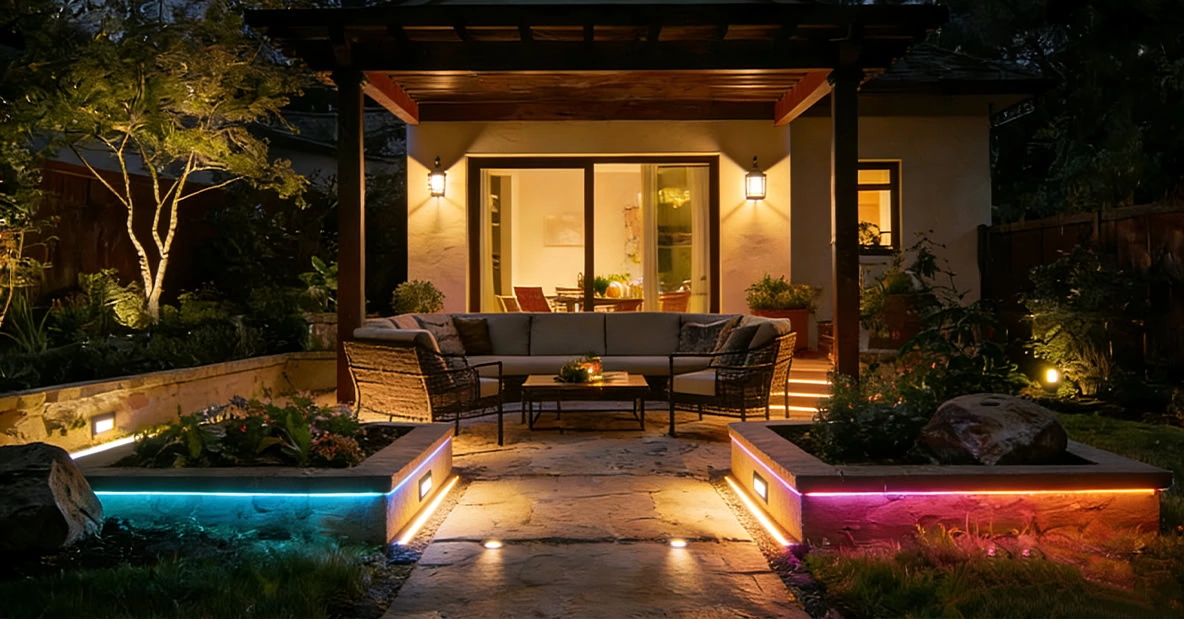
Besoins fondamentaux: Flexibilité multi-scènes (rassemblements/repas), ambiance chaleureuse, éclairage axé sur la tâche.
Bandes lumineuses flexibles: Low voltage strips in single color, RGB or RGBW versions create festive or relaxed atmospheres for patio seating. Each version needs its matching controller.
Appliques murales LED à intensité variable: dimming adapts the light to dining, conversation or quiet relaxation; the dimming range and the compatible driver or controller are confirmed for the model quoted.
Pourquoi nous recommandons ceci: Flexible strip lights follow curves and install out of sight, and they are cut only at their marked cut points and resealed as the instructions describe. Sealed LED wall lights give steady, dimmable light for outdoor seating. Resort and hotel courtyards use the same pairing, planned together with the pool and terrace on our hotel lighting page.
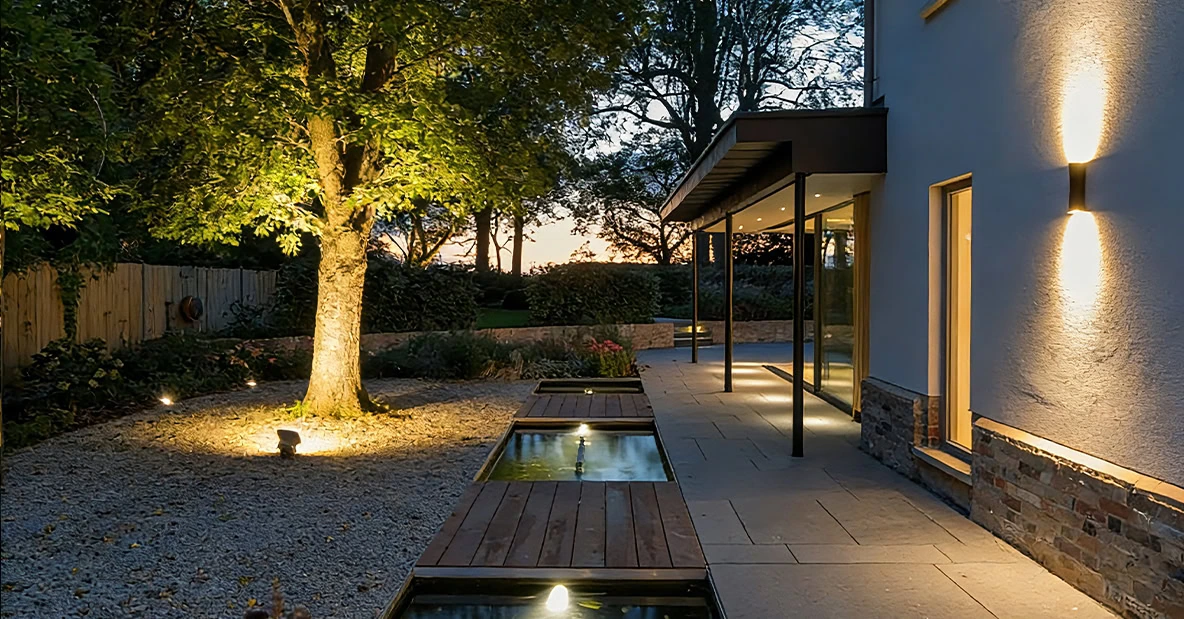
Besoins fondamentaux: Mettre en surbrillance les couches du paysage, préserver l'esthétique, avoid light pollution.
Lampes sur piquets de jardin: The flexible finishing touch for garden lighting. They can be moved and re-aimed as the planting grows, éclairant facilement le centre du paysage, with mains, low voltage and solar versions depending on the model.
Lumières de paysage d’inondation: With a wide beam and high output, they cover large areas of planting evenly and create layers of light and shadow, with dimming and glare control accessories available on selected models.
Pourquoi nous recommandons ceci: Les lumières sur pointes offrent la flexibilité nécessaire pour mettre en évidence des points focaux précis, tandis que les projecteurs assurent une uniformité, éclairage sur une vaste zone qui façonne les couches globales d'un espace. Uplights and floods are aimed into the planting, shielded where they could be seen from windows or seats, and switched off or dimmed late at night, which keeps the light where it is wanted and limits light pollution.
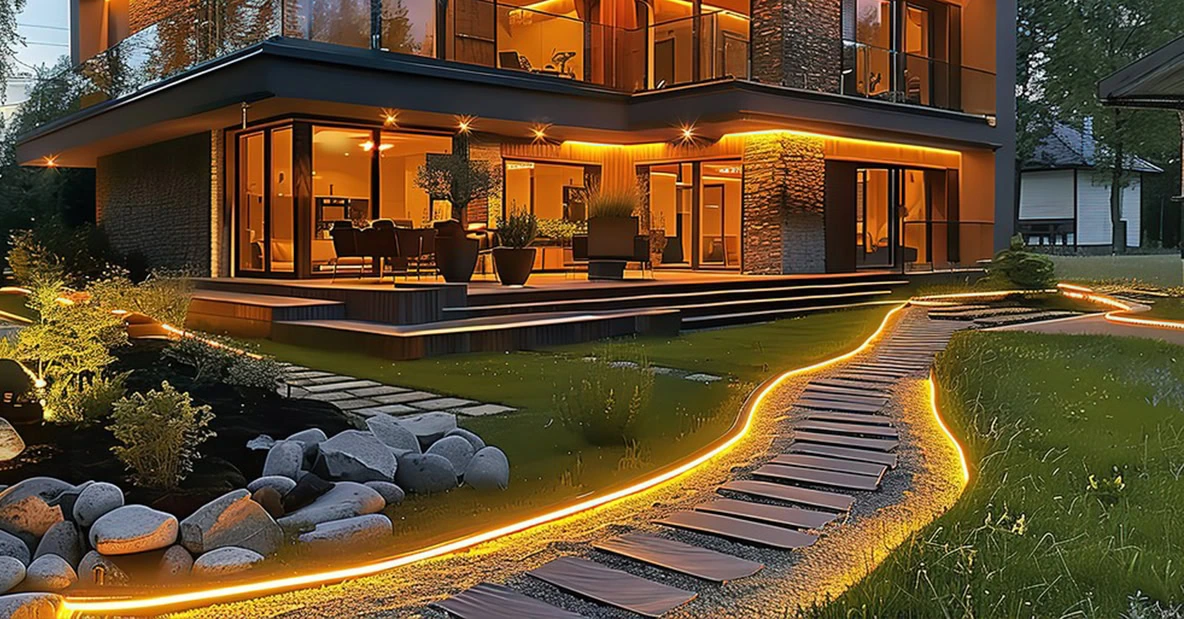
Besoins fondamentaux: Dans le but d'assurer la sécurité de la marche et des conseils clairs, créer une atmosphère nocturne confortable et belle.
Feux de dessus de poteau: Mains powered post tops run from 30W to 100W at up to 130 lumens per watt with IP66 and IK09 protection, and a solar series (20W to 40W) charges by day and switches on at dusk where cabling is not practical.
Bandes lumineuses au néon: Continuous linear light gives walkways a decorative, modern line that goes beyond basic lighting.
Lumières enracinées: Rated IP67, they are protected against dust and against temporary immersion under the test conditions. Where rain can collect, they need a drainage bed under the fixture, a sealed cable connection and the installation sleeve, fitted as the instructions describe. Pools and fountains need fixtures made and rated for underwater use.
Pourquoi nous recommandons ceci: LED neon lights are used for creative decoration and atmosphere in courtyards, and post top lights are recommended for large scale, energy saving base lighting. The two can be combined to achieve a combination of function and aesthetics.
Path light levels for a private courtyard are set by the project brief and any local rules; DANS 13201 covers public roads and paths, not private courtyards. Bollard spacing comes from the bollard's photometric file and the path's width, surface and target light level, so it is set in the calculation rather than by a fixed rule. Notre bornes d'éclairage come in single sided and double sided versions for paths lit from one side or both.
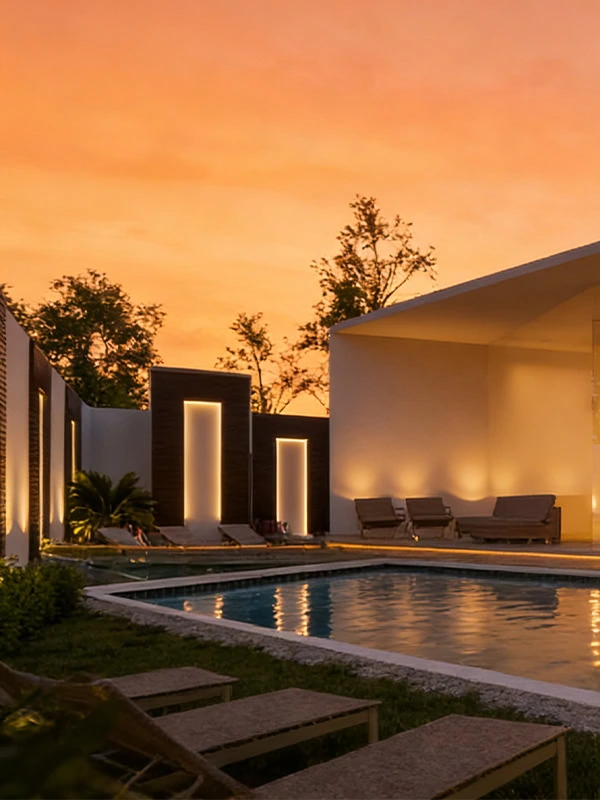
The right courtyard lighting makes your outdoor area a warm, inviting and fully usable extension of the building after sunset. Each lighting category serves a distinct purpose. Here is a breakdown of the key options:
Comme le plus "original" méthode d'éclairage, natural light not only illuminates the courtyard for free but also adds to the space's transparency and comfort. La lumière du soleil se répand sur les plantes, terrasses, ou les jeux d'eau créent naturellement une atmosphère relaxante, making the courtyard more lively.
L'éclairage artificiel est la principale source de lumière pour les cours la nuit. Il est en outre divisé en 3 types basés sur des différences fonctionnelles:
1. Éclairage ambiant
But: Pour fournir du doux, éclairage de base uniforme qui crée une atmosphère générale chaleureuse pour le système d'éclairage de la cour, s'assurer que l'espace est confortablement éclairé et jamais trop sombre.
2. Éclairage de travail
But: Pour livrer de manière ciblée, une lumière plus vive sur des zones spécifiques, répondre aux besoins pratiques et assurer la sécurité et la commodité des activités dans le cadre du plan d’éclairage de la cour.
3. Éclairage d'accentuation
But: Pour mettre en valeur artistiquement des éléments architecturaux ou des éléments paysagers clés, using light to direct visual interest and bring out the depth and appeal of the courtyard lighting design.
• Lumens: as rough product outputs, 100 à 300 lumens suit ambient lighting, 300 à 800 lumens accent lighting and 800 à 5000 lumens task and safety lighting. Lumens describe what a fixture emits, not the light that lands on a path or wall; the optics, mounting height and aiming decide that, so larger and commercial courtyards are planned by the light on each surface in a calculation.
• TCC: 2700K à 3000K (blanc chaud) is the usual default for courtyards, especially near bedrooms, wildlife habitat and quiet seating; 4000K à 5000K (blanc froid) suits functional areas where the project calls for it, and RGB options support color scenes. Keeping one color temperature across a view gives a calm result, though a designer may vary it on purpose.
• Evaluate your courtyard's size, mise en page, et zones clés (par ex., pelouses, terrasses, jeux d'eau) pour déterminer les types et les quantités d'éclairage requis.
• Sélectionnez l'éclairage en fonction de cas d'utilisation spécifiques.: Par exemple, pair dimmable accent lights with leisure areas and use brighter task lights for dining zones. Where motion sensors are used, set them so paths never go fully dark and lights do not switch on and off with passing movement.
• Tenez compte de la complexité de l'installation: solar courtyard lighting avoids trenching for mains cable, but it still needs mounting and internal wiring, while mains and low voltage products are installed by a qualified electrician to local rules.
• Choose low maintenance products (par ex., enceintes scellées, accessible drivers, piles remplaçables) and plan access to drainage and cable connections for inspection.
• Choose courtyard lighting products with at least IP65 for exposed areas to withstand rain, snow and humidity. IP67 adds protection against temporary immersion under the test conditions; continuous submersion in pools or fountains needs fixtures made and rated for underwater use.
• The IP rating covers dust and water only. Corrosion, Exposition aux UV, load from foot or vehicle traffic over inground lights and the lens surface temperature each need their own check; on coastal or pool side sites, ask for the coating system, gasket material and stainless fixings of the model quoted.
• Check the rated life on each model's datasheet, together with its test conditions, to plan replacement and maintenance.
• LED fixtures can use up to 80% less energy than incandescent and halogen lamps delivering the same light, which reduces electricity costs.


Lumière enterrée

Projecteur de paysage

Lumière du jardin solaire

Bande lumineuse flexible
Light a courtyard in layers: inground or bollard lights for safe paths, dimmable strip lights for a cozy ambiance in seating zones, uplights on trees and features, and up and down wall lights on exterior walls for architectural depth. Start from a warm color temperature, aim and shield each fixture so it cannot be seen from the windows that overlook the space, and dim or switch off accent light late at night.
IP65 is a common minimum for exposed areas, and IP67 adds protection against temporary immersion under the test conditions. Neither makes a fixture suitable for continuous submersion: pools and fountains need fixtures made and rated for underwater use, installed to local electrical rules. Inground lights also need drainage underneath, and coastal sites need the right coating and fixings, because IP covers dust and water, not corrosion.
Install adjustable uplights or spotlights on focal points such as trees and sculptures; as an illustrative starting point, à propos 2 à 3 times the surrounding light level reads as clear emphasis. The visible effect also depends on the surface's reflectance, the beam, the viewing angle and the surrounding light, so narrow beams suit slender trees and statues, wider beams suit broad canopies, and the final aim is set on site after dark.
Solar suits low wattage fixtures such as garden and post top lights on sunny, unshaded sites, while hardwired systems suit higher output fixtures such as wall lights and floods. Solar autonomy depends on the battery's usable capacity, the load and dimming profile, temperature and the site's winter sun, so ask for the sizing for the model and site. Solar avoids mains trenching but still needs mounting and internal wiring.