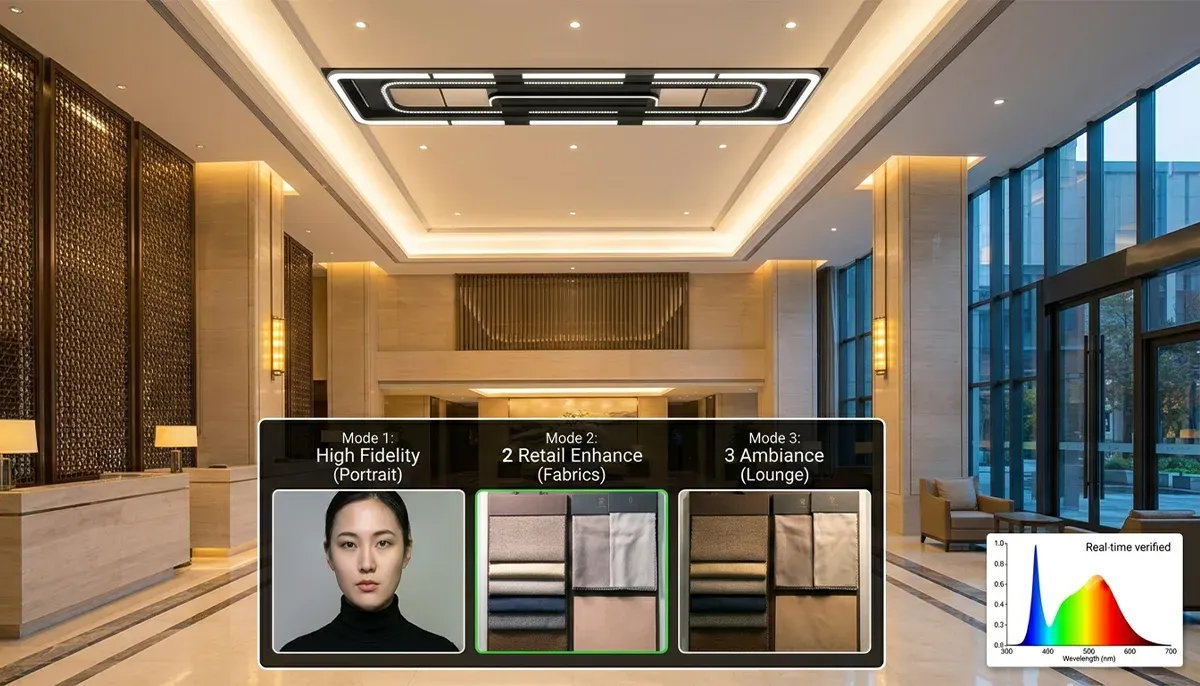
You selected Ra95 full spectrum LED lighting, but after installation, hotel walls looked dull, luxury materials lost texture, and skin tones appeared unnatural. If you’ve experienced this, you’re not alone. The problem often isn’t CRI—it’s the spectrum behind the light.
In modern architectural lighting projects, visual quality is often assumed to be determined by simple specifications such as CCT and CRI. However, real-world results frequently show a completely different outcome.
The core issue is simple: Lighting quality is not defined by labels. It is defined by spectral power distribution (SPD).
There is currently no unified global standard for “Full Spectrum LED Lighting” defined by organizations such as CIE or IES. In practice, the term is used in inconsistent ways across the lighting industry.
Many manufacturers use “full spectrum” as a marketing term to imply natural light-like performance. However, this is not based on measurable spectral criteria.
Some products label Ra90–Ra98 LEDs as “full spectrum lighting”. However, CRI only evaluates average color deviation based on a limited set of test colors, and does not represent full spectral completeness.
A more scientific interpretation is based on spectral power distribution (SPD), which describes the actual energy output across visible wavelengths.
👉 Key insight:
Because there is no standardized definition, “full spectrum” often describes marketing intent rather than measurable performance.
CRI (Ra) is a widely used metric in lighting specification, but it has significant limitations when applied to real architectural environments.
CRI evaluates only a small set of standard color samples. These do not represent real-world materials such as:
CRI does not directly analyze spectral distribution. As a result, two light sources with identical Ra values can produce completely different visual results.
Standard CRI does not include R9 (saturated red), which is critical for:
Different spectral distributions can produce similar CRI results under test conditions but behave differently in real environments.
👉 Conclusion:
CRI is a simplified laboratory index, not a reliable predictor of real visual performance.
SPD describes how energy is distributed across different wavelengths of visible light. It is the physical foundation of how humans perceive color.
Unlike CRI or CCT, SPD directly determines how materials interact with light.
Different wavelength regions influence different visual outcomes:
If any region is underrepresented, visual imbalance occurs even if CRI is high.
CRI and TM-30 are evaluation systems, but SPD is the actual cause of what we see.
👉 Key takeaway:
If SPD is different, visual performance will always be different—even under identical specifications.
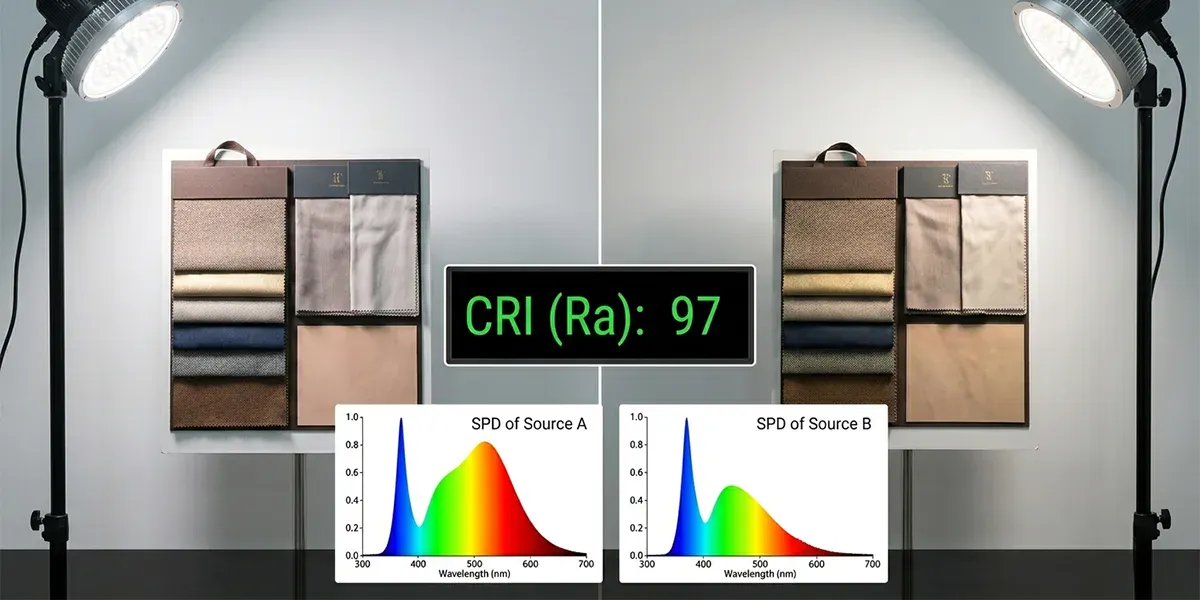
Even when color temperature (e.g., 3000K) and CRI (Ra≥95) are identical, lighting results can still vary significantly.
The reason lies in spectral structure differences:
In a hospitality lighting project, two LED luminaires with identical specifications (3000K, Ra95) were installed in the same environment.
One produced warm, natural skin tones and a premium atmosphere. The other caused marble surfaces to appear dull and slightly gray.
Further SPD analysis revealed a deficiency in the deep red wavelength region, resulting in poor R9 performance despite identical CRI values.
This demonstrates a critical truth: Lighting performance is determined by spectral composition, not specification labels.
Professional lighting evaluation requires more than CRI.
R9 directly affects:
Low R9 often leads to “cold” or “flat” visual appearance.
TM-30 provides a more complete evaluation system:
Unlike CRI, TM-30 evaluates both accuracy and color richness.
Duv determines whether white light appears:
Even small deviations significantly affect perceived lighting quality in architectural spaces.
Spectral imbalance is not just a technical issue—it directly affects commercial performance.
Hospitality Projects
Lighting inconsistency reduces perceived luxury and spatial comfort.
Poor spectral rendering reduces product attractiveness and brand perception.
Architectural Spaces
Materials lose depth, texture, and dimensionality.
👉 In many cases, lighting quality directly influences customer experience and commercial value.
Do not rely solely on CRI when evaluating LED lighting performance. A professional evaluation should include:
Lighting should always be evaluated under real project conditions rather than laboratory data alone.
Modern LED systems are evolving toward multi-channel spectral control technology. This allows lighting systems to adjust spectral output for different applications:
👉 This represents a shift from fixed lighting to application-driven spectral optimization.
To avoid performance mismatches, professional specification should include:
These parameters ensure consistent and predictable lighting performance in real projects.
Many lighting issues occur not because of product quality, but because of incomplete specification standards.
Before selecting fixtures, always ensure:
A structured evaluation process significantly reduces project risk.
Full spectrum lighting does not automatically guarantee better visual results in real projects. CRI alone is not sufficient to evaluate lighting quality.
A more reliable approach is based on:
SPD + R9 + TM-30 + Duv
Together, these metrics provide a complete understanding of real lighting performance.
If you are selecting LED lighting for hospitality, retail, office, or architectural projects, relying on CRI alone can lead to unexpected visual results.
We help lighting designers, contractors, and project teams evaluate lighting performance based on real spectral data, not marketing labels.
Contact our engineering team to discuss your project lighting requirements.
Not necessarily. Visual comfort depends on many factors, including glare control, luminance distribution, color temperature, flicker performance, and fixture design. At GS LIGHT, we often find that well-controlled optics and low-glare fixture designs have a greater impact on comfort than spectrum alone.
Full spectrum lighting may create a more natural visual environment, but eye strain is usually related to brightness levels, glare, screen exposure, and visual tasks. Proper lighting design is generally more important than spectrum alone when reducing visual fatigue.
Not always. For photography and video applications, color consistency, spectral stability, TLCI, and SSI values are often more important than the “full spectrum” label. A lighting system should be selected based on camera performance requirements rather than marketing terminology.
Circadian rhythm is influenced by spectrum, light intensity, timing, and duration of exposure. Full spectrum lighting alone does not automatically support circadian-friendly environments. Human-centric lighting requires a more comprehensive lighting strategy.
Natural daylight changes continuously throughout the day in spectrum, intensity, and color temperature. Most LED systems can only approximate certain characteristics of daylight. GS LIGHT typically recommends evaluating daylight simulation based on project requirements rather than relying solely on “full spectrum” claims.
Yes. Since there is no globally accepted standard for full spectrum lighting, manufacturers may use different criteria when describing their products. This is why reviewing technical documentation is essential during product evaluation.
No. Different projects have different priorities. Hospitality, retail, office, museum, and landscape lighting applications often require different lighting strategies.The best lighting solution depends on project goals rather than a single specification.
LED binning affects color consistency between fixtures. Poor bin control can lead to visible color variations, especially in large-scale installations. For hospitality and architectural projects, GS LIGHT typically recommends tighter SDCM control to maintain visual consistency.
Lighting performance can change due to mounting height, beam angle, surrounding materials, ambient light conditions, and viewing distance. For this reason, GS LIGHT frequently recommends on-site mock-up testing before final fixture selection.
Professional designers typically request LM-79 reports, TM-30 data, SPD curves, SDCM information, flicker reports, and warranty documentation. At GS LIGHT, these documents are commonly provided during the specification process to support lighting consultants and architects.