Steel mills, foundries, smelting plants, glass factories, cement plants, boiler rooms, and heavy workshops expose lighting to heat, dust, vibration, and unstable power—often during long shifts with limited maintenance access. Choosing high temperature LED lighting is therefore not simply a question of lumen output or price. The luminaire must provide useful light while protecting its LED source, driver, and internal electronics.
This guide explains what to evaluate and shares lessons from a GS Light high-temperature UFO high-bay project supplied to a Saudi steel mill, where 20 sample units completed a one-year field evaluation before bulk purchasing.
Quick answer: For high-temperature industrial lighting sites, confirm the real ambient temperature at the mounting point, thermal-management design, driver reliability, IP/IK protection, surge protection, maintenance access, and the availability of a real sample trial. A standard high bay is not automatically suitable for an extreme-heat facility.
Before comparing fixtures, understand what the luminaire will experience after installation. A building’s average temperature is not enough: heat collects near roofs, furnace lines, kilns, cranes, and production equipment, while radiant heat can be more severe than hot air.
Confirm mounting height, spacing, target lux level, operating hours, voltage, dust, oil mist, humidity, corrosive gases, vibration, and maintenance access. Also identify furnaces, rolling mills, large motors, cranes, welding equipment, and variable-frequency drives that may cause voltage fluctuations during operation.
Many standard LED high bays are designed for normal warehouses. Extreme heat changes the operating conditions inside the luminaire. High ambient temperature accelerates the ageing of drivers, capacitors, and other electronic components. Weak heat dissipation can cause faster lumen depreciation, reduced brightness, repeated thermal protection, or premature failure.
Dust can reduce heat dissipation, vibration can stress connectors and mountings, and transient surge events can damage drivers and control circuits. Combined with continuous heat, these factors leave a standard luminaire with a much smaller reliability margin.
For this reason, ordinary industrial high bays and high temperature LED lighting should not be treated as the same product category. In demanding facilities, lighting must do more than provide brightness. It must manage internal heat and protect critical components over the long term.

Ask for the specific maximum ambient-temperature rating of the proposed model. Phrases such as “heat resistant” are not enough. The rating should cover the actual temperature around the installed fixture, with an appropriate safety margin. It should also be clear whether the stated photometric performance, warranty, and operating conditions apply at that temperature.

High-temperature performance depends on the whole system: LED module, heat-dissipation design, driver, wiring, optics, and sealing materials. Review the driver specification and serviceability—not only the LED brand or nominal efficacy.

High temperature affects the service life of electronic components, especially the LED driver. Review the driver specification, installation arrangement, replacement method, and service availability—not only LED brand or nominal efficacy.
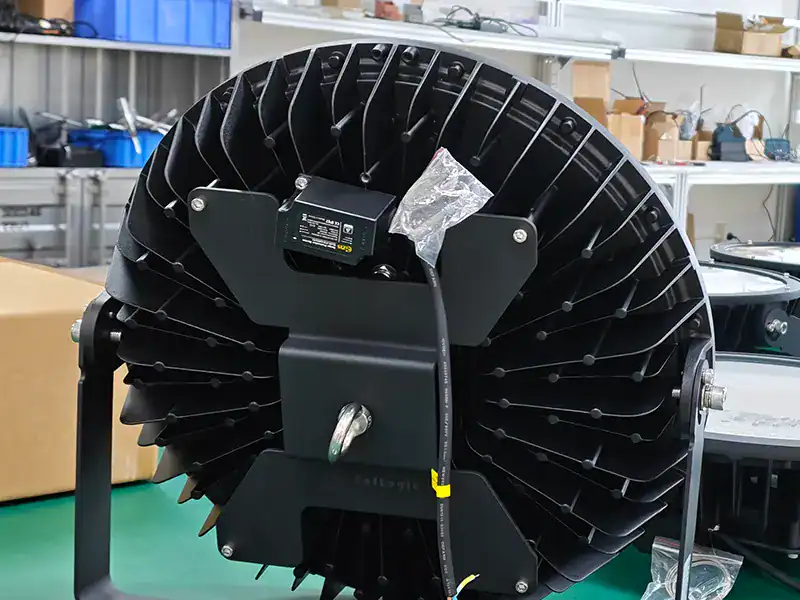
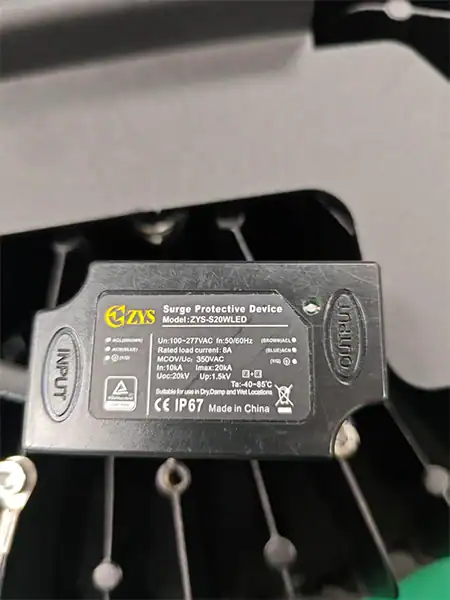
Surge protection should be checked separately. In high-temperature industrial facilities, large equipment can create voltage fluctuations and transient surge events during switching and operation. These disturbances may damage LED drivers and sensitive electronic components.
To provide additional protection in this type of environment, GS Light high-temperature UFO high bays are equipped with a built-in 20kV surge protection device (SPD). It helps protect the driver and internal electronic components against surge-related damage caused by demanding industrial power conditions.
The required protection level depends on the site. Dust and water ingress, impact, vibration, and corrosion must all be considered. A suitable fixture needs the protection level appropriate to its actual environment, rather than a generic industrial label.
The fixture should have a clear protection strategy for excessive internal temperature. Automatic power reduction can be preferable to exposing the LED module and driver to prolonged thermal stress. The lighting design should include suitable illuminance and uniformity margins.
GS Light developed its high-temperature UFO high-bay range for applications where a conventional high bay may not provide enough thermal or electrical protection. It is designed for ambient temperatures of up to 90°C, with efficacy of up to 160 lm/W, IP66 protection, IK10 impact resistance, intelligent automatic power reduction, and a built-in 20kV SPD.


It is suitable for steel mills, foundries, smelting plants, glass factories, boiler rooms, and other high-temperature workshops. The final wattage, beam angle, mounting method, and quantity should still be based on a lighting calculation and site review.

The automatic power-reduction function is a key difference between a conventional high bay and a luminaire designed for high-temperature operation. When operating temperature becomes excessive, the GS Light high-temperature UFO automatically reduces part of its power output to control internal heat. This intelligent thermal protection helps protect the LED source, driver, and other electronic components during long-term operation in extreme industrial environments.

The Saudi Steel Mill project shows why a long-term trial is more meaningful than a specification comparison. GS Light supplied high-temperature UFO high-bay samples for a steel-mill application through Mitwalli Group.
The customer first purchased 20 sample units rather than moving directly to a full order.
The fixtures were evaluated in actual working conditions for one full year. The purpose was to assess stability, lighting performance, driver reliability, and maintenance risk under heat, dust, continuous operation, and nearby large equipment.
After the field test, the customer was satisfied with the product and service and proceeded with bulk purchasing.
This case should not be understood as a promise that every site has identical conditions or results. It is evidence that high-temperature lighting should be validated in the environment where it will operate. For critical facilities, a controlled sample installation remains one of the best ways to reduce technical and commercial risk before a large purchase.
Do not compare high-temperature luminaires by price, wattage, or quoted lumens alone. Ask for a current datasheet, ambient-temperature range, photometric file, installation guidance, protection documentation, and warranty conditions. Include electrical surge exposure in the risk assessment: a built-in 20kV SPD strengthens fixture-level protection, although it does not replace a site-wide electrical-protection strategy.
For a large or high-risk installation, begin with a sample evaluation. A field trial helps the facility team confirm light distribution, installation method, thermal behaviour, and long-term stability before a full order.
GS Light high-temperature UFO high bays are suitable for steel mills and rolling mills, foundries and smelting plants, glass factories, cement plants, boiler rooms and power plants, chemical-processing facilities, heavy manufacturing workshops, and other high-temperature industrial environments.
The answer depends on the fixture’s rated operating range and the actual temperature at the mounting point. Any application approaching or exceeding the rating of a standard industrial fixture should be evaluated as a high-temperature project.
Not automatically. The fixture must be checked for temperature capability, dust and impact protection, vibration, surge exposure, and maintenance conditions. A standard high bay may be suitable for some areas but not for locations close to heat-intensive processes.
Automatic power reduction is a thermal-protection function. When temperature becomes excessive, it helps control internal heat and protect the LED source, driver, and electronic components from prolonged thermal stress.
Large equipment can cause transient electrical surges that damage sensitive electronics. A built-in 20kV SPD provides added fixture-level protection for the driver and internal components in demanding industrial power environments.
Please provide the ambient temperature near the fixture, mounting height, layout or dimensions, required lux level, voltage, operating hours, quantity, and site photos. This allows a project-specific recommendation and lighting calculation.
GS Light supports high-temperature industrial projects with UFO high-bay selection, photometric files, lighting calculations, mounting options, and sample evaluation. Share your project conditions and our team can recommend a suitable high-temperature LED lighting solution before you place a full order.