Planning a warehouse lighting project? You need the right lux level to ensure safety and efficiency without wasting energy. Understanding how to calculate lux is an essential step in determining the correct lighting requirements for your space. This guide helps you calculate warehouse lux requirements and estimate how many high bay lights your facility needs.
Lux is the unit used to measure illuminance, which refers to the amount of light reaching a specific surface area. One lux equals one lumen distributed over one square meter. In warehouse lighting, lux indicates how bright the working area actually appears to employees and equipment operators.
Lumens measure the total amount of light produced by a fixture, while lux measures the light received on a surface. For example, two LED high bay lights may produce the same lumen output, but the resulting lux level can vary depending on mounting height, beam angle, and fixture spacing.
Proper lux levels improve visibility, reduce accidents, enhance picking accuracy, and support employee productivity. Achieving the correct warehouse lighting level also helps ensure compliance with project specifications and customer requirements.
Different warehouse activities require different illumination levels.
| Warehouse Area | Recommended Lux |
| General Storage | 100-200 Lux |
| Picking Areas | 200-300 Lux |
| Packing Stations | 300-500 Lux |
| Loading Docks | 150-300 Lux |
General storage areas typically require lower illumination because workers spend less time performing detailed tasks. In contrast, picking and packing zones need higher lux levels to improve accuracy and reduce errors. Choosing the appropriate lighting level helps balance visibility and energy efficiency.

The simplest way to estimate warehouse illuminance is:
Lux = Total Lumens ÷ Area (m²)
This formula provides a basic estimate, but actual performance depends on several factors:
For large warehouses, a professional lighting simulation is recommended to verify actual illumination levels and uniformity.
Assume a warehouse has:
Required Lumens = Target Lux × Area
Required Lumens = 200 × 1,000
Required Lumens = 200,000 Lumens
Suppose each LED high bay light produces 30,000 lumens.
Number of Fixtures = 200,000 ÷ 30,000
Number of Fixtures = 6.67
In practice, you would select 7 fixtures as a starting point.
The required number of fixtures depends on warehouse size, target lux level, and fixture lumen output.
| Warehouse Size | Target Lux | Approximate High Bay Quantity |
| 500 m² | 200 Lux | 4 Units |
| 1,000 m² | 200 Lux | 7 Units |
| 2,000 m² | 200 Lux | 14 Units |
These figures are intended for preliminary planning. Final fixture quantities should be verified through a lighting layout and simulation.
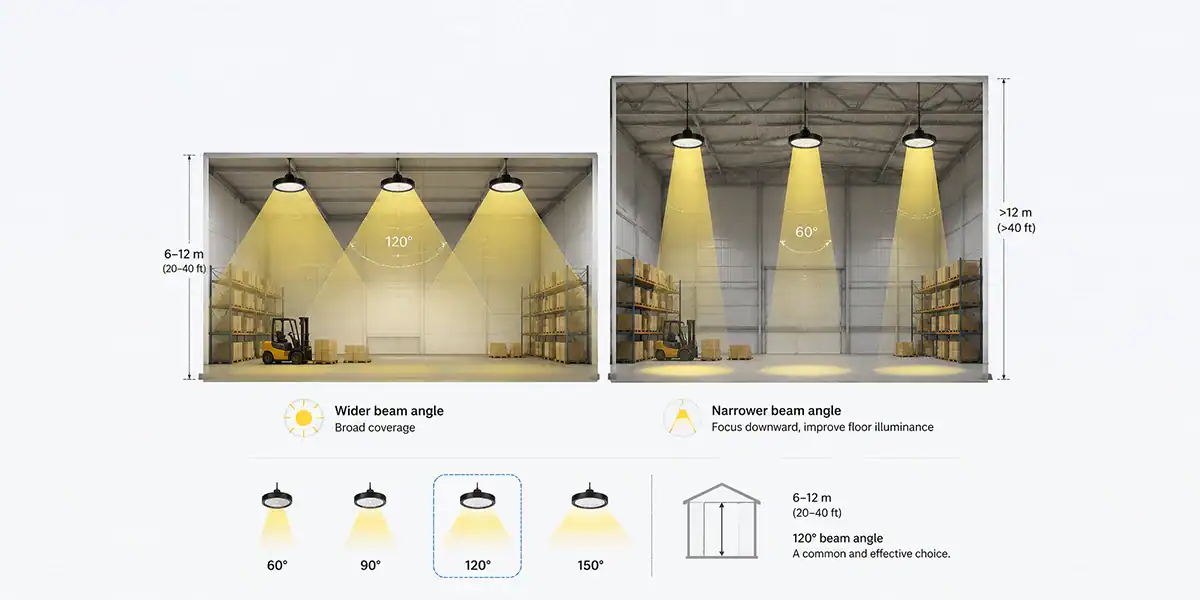
Mounting height is the primary factor in selecting the right fixture type. As a general rule, spaces with ceiling heights exceeding 4.5 meters (15 feet) require high bay lighting. For very high ceilings, such as over 12 meters (40 feet), fixtures with narrower beam angles are often needed to ensure sufficient light reaches the floor level.
Lumen output is the most direct measure of a fixture’s brightness. Because high bay lights are installed at significant heights, they must produce enough lumens to adequately illuminate large floor areas. As a rough guideline:
Always compare fixtures based on lumen output rather than wattage alone.
Beam angle determines how light spreads across the work area.
For ceiling heights between 6 and 12 meters (20–40 ft), a 120° beam angle is a common and effective choice.
Color temperature affects visibility and worker alertness. For warehouse environments where concentration and accuracy are important, cool white light in the 4000K–5000K range is recommended. This color temperature enhances contrast and helps workers stay focused during long shifts.
The IP rating indicates a fixture’s resistance to dust and moisture.
Choose a rating that matches the specific conditions of your facility.
If you have higher ceilings in your warehouse, you need higher lumen output or additional light fixtures to maintain adequate illumination at floor level. You will fail to meet standard lighting requirements if you neglect the impact of mounting height on overall brightness.
You should note that wattage only measures power consumption, not actual light output. When you select warehouse lighting fixtures, you must always compare products based on their lumens and luminous efficacy instead of judging quality by wattage alone.
You should know that average lux is only one indicator of qualified warehouse lighting. If you arrange fixtures improperly, poor placement will create dark areas and shadows in your warehouse space. These lighting flaws will directly jeopardize on-site safety and reduce your overall operational productivity.
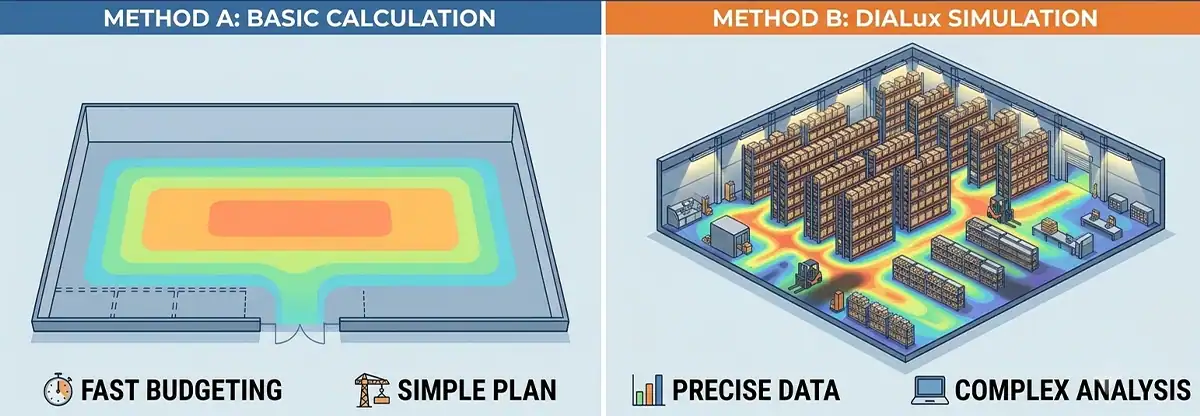
Simple lux calculations are useful for early-stage budgeting and fixture estimation. However, large warehouses often contain racks, equipment, and varying ceiling heights that affect light distribution.
A DIALux simulation provides a more accurate analysis by showing:
For logistics centers, distribution facilities, and high-rack warehouses, lighting simulation is strongly recommended before installation.
Yes. For general storage and standard warehouse operations, 200 lux is commonly considered adequate.
To calculate lux (light intensity) from lumens (total light output), divide the lumens by the illuminated area in square meters (assuming all luminous flux is uniformly distributed over that area). The core formula is: Lux (lx) = Luminous Flux (lm) / Area (m²).
Yes. Many LED high bay fixtures support 0-10V, DALI, or smart control systems, allowing you to reduce energy consumption during low-occupancy periods.
For most indoor warehouses, IP65 protection is sufficient. Cold storage or washdown environments may require higher ratings such as IP69K.
High-quality LED high bay fixtures typically provide 50,000 to 100,000 hours of service life, significantly reducing maintenance requirements.
For large or complex warehouses, DIALux simulation is highly recommended to ensure proper illuminance and uniformity.