Choosing the wrong IP rating can lead to premature fixture failure, costly maintenance, and unnecessary expenses.This guide explains the differences between IP65, IP66, and IP67 to help you choose the right waterproof LED lighting for your project.
An IP (Ingress Protection) rating is an international standard defined by IEC 60529 that measures how well an electrical enclosure is protected against the intrusion of solid objects and liquids.
An IP rating consists of two digits:
For example, in IP65, the “6” means the fixture is completely protected against dust, while the “5” means it can withstand low-pressure water jets from any direction.
For outdoor LED lighting, the second digit is usually the most important, as it determines how well the fixture can resist different weather conditions and water exposure. Understanding these ratings makes it easier to choose between IP65, IP66, and IP67 for your specific application.
IP65 means the fixture is completely protected against dust ingress and can withstand low-pressure water jets from any direction.
It is one of the most common protection levels used for outdoor LED lighting and is suitable for installations exposed to rain and normal weather conditions.
Advantages
Limitations
Typical applications:
IP66 provides the same complete dust protection as IP65 but offers a higher level of water resistance.
It is designed to withstand powerful water jets and severe weather, making it one of the most popular specifications for commercial outdoor lighting.
Advantages
Limitations
Typical applications:
IP67 offers complete dust protection and can survive temporary immersion in water, typically up to 1 meter for 30 minutes.
It is designed for locations where accidental flooding or standing water may occur.
Advantages
Limitations
Typical applications:
The first digit of an IP rating indicates protection against solid objects and dust.
| Rating | Protection Level |
| 0 | No protection |
| 5 | Dust-protected |
| 6 | Dust-tight |
IP65, IP66, and IP67 all carry a first digit of 6, meaning they are completely protected against dust ingress.
As a result, there is no practical difference in dust protection between these three ratings. All are suitable for outdoor environments exposed to sand, dirt, or airborne particles.
Winner: Tie (IP65 = IP66 = IP67)
The second digit determines resistance to water and represents the most important difference between IP65, IP66, and IP67.
| Rating | Water Protection |
| IP65 | Water jets |
| IP66 | Powerful water jets |
| IP67 | Temporary immersion |
An IP65 fixture can withstand rain and normal outdoor exposure.
IP66 provides additional protection against heavy rain, storms, and high-pressure water jets.
IP67 goes one step further by surviving temporary immersion in water up to 1 meter for 30 minutes.
For outdoor LED lighting, this is usually the deciding factor when selecting an IP rating.
Outdoor lighting fixtures often face rain, snow, wind, and seasonal weather changes.
IP65 performs well in ordinary outdoor environments.
IP66 offers better protection in regions with frequent storms, heavy rainfall, or harsh weather conditions.
IP67 is recommended where water accumulation or temporary flooding may occur.
The more severe the environment, the more valuable higher water protection becomes.
The installation location has a major influence on the required IP rating.
IP65 is suitable for:
IP66 is suitable for:
IP67 is suitable for:
Generally, higher waterproof performance requires more advanced sealing structures and testing procedures.
Cost typically follows this pattern:
IP65 < IP66 < IP67
However, choosing the highest rating is not always the most economical solution.
For many outdoor projects, IP66 provides the best balance between performance and cost.
A higher IP rating can help prevent moisture ingress and reduce maintenance requirements.
However, IP rating alone does not determine product lifespan.
Other factors such as:
often have a greater impact on long-term reliability.
A well-designed IP65 fixture can outperform a poorly designed IP67 fixture.
| Application | Recommended IP Rating |
| Garden & Pathway Lights | IP65 |
| Wall-Mounted Outdoor Lights | IP65–IP66 |
| Building Façade Lighting | IP66 |
| Street & Roadway Lighting | IP66 |
| Floodlights & Spotlights | IP66 |
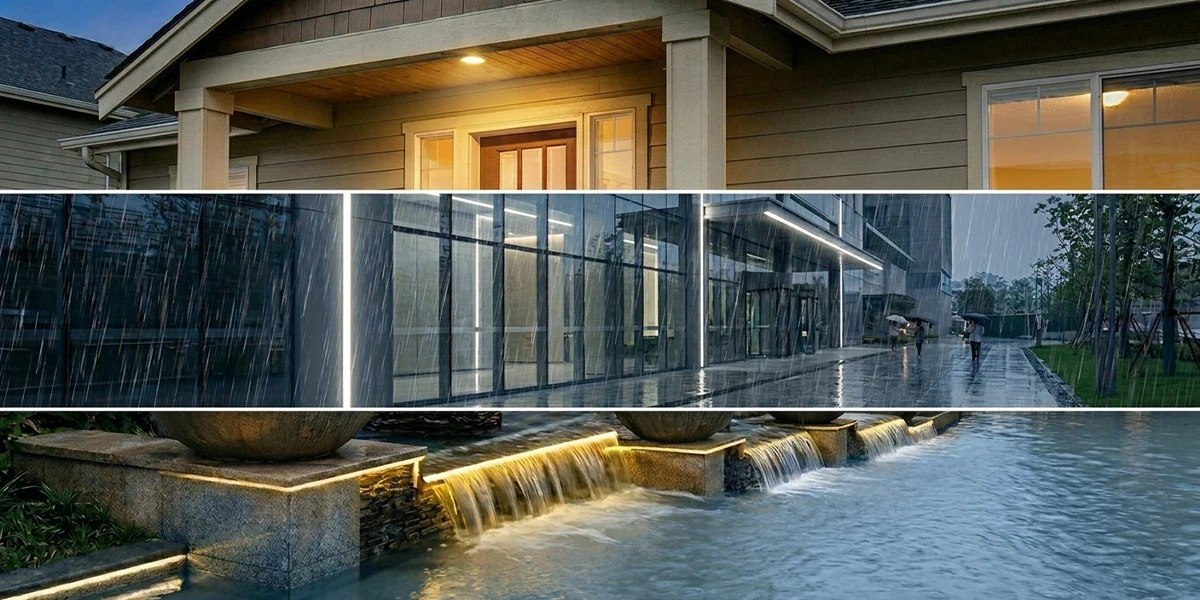
| Flood-Prone Areas | IP67 |
| Near Fountains & Water Features | IP67 |
| Permanent Underwater Lighting | IP68 |
| Comparison Item | IP65 | IP66 | IP67 |
| Dust Protection | Dust-tight (Level 6) | Dust-tight (Level 6) | Dust-tight (Level 6) |
| Water Protection | Low-pressure water jets | Powerful water jets | Temporary immersion (up to 1 m for 30 min) |
| IEC 60529 Test Condition | 12.5 L/min water jet | 100 L/min powerful water jet | Immersion up to 1 m for 30 minutes |
| Suitable for Heavy Rain | ✅ Yes | ✅ Yes | ✅ Yes |
| Suitable for Temporary Immersion | ❌ No | ❌ No | ✅ Yes |
| Suitable for Permanent Underwater Use | ❌ No (IP68 required) | ❌ No (IP68 required) | ❌ No (IP68 required) |
| Typical Applications | Garden lights, pathway lights, landscape lighting | Street lights, floodlights, façade lighting | Flood-prone areas, water features, fountain surroundings |
| Relative Cost | Low | Medium | High |
IP65 Is the Best Choice for Protected Outdoor Lighting Applications
IP66 Is Recommended for Most Outdoor LED Lighting Installations
IP67 Is Ideal for Locations with Temporary Water Immersion Risks
If you’re unsure which rating to choose, IP66 is generally the safest and most versatile option for most commercial outdoor LED lighting projects.
Choosing between IP65, IP66, and IP67 is not about selecting the highest rating—it is about matching the level of protection to the actual installation environment.
By understanding the differences in dust resistance, water protection, application scenarios, and cost, you can select the most appropriate IP rating to ensure reliable performance while avoiding unnecessary expenses.
If you’re planning an outdoor LED lighting project and need help selecting the right waterproof solution,the GS Light team is happy to provide technical advice and recommend fixtures based on your specific application and project requirements.
Yes. IP65 is sufficient for most landscape lighting applications, including garden paths, wall lights, and decorative outdoor fixtures. If the installation area is prone to water accumulation, IP66 or IP67 may offer better long-term protection.
Yes. IP66 is one of the most commonly specified ratings for outdoor LED lighting because it provides excellent protection against heavy rain and water jets. For most commercial, municipal, and landscape projects, IP66 is more than sufficient.
Yes. IP65-rated fixtures are designed to withstand rain, splashing water, and outdoor exposure. However, for harsh weather conditions or locations exposed to strong water jets, IP66 is generally the safer option.
No. IP67 is intended for temporary immersion only. For fountains, ponds, swimming pools, or other continuously submerged applications, IP68-rated lighting should be used.
Don’t rely only on the IP rating listed on a datasheet. To verify a fixture’s actual protection level, ask the supplier for an IEC 60529 test report from an accredited laboratory and confirm that the test covers the complete fixture, including connectors and cable glands. It’s also a good idea to review the sealing design, warranty terms, and real-world project experience to ensure long-term outdoor reliability.
Not always. While a higher IP rating improves resistance to dust and water, factors such as thermal management, driver quality, and housing materials have a greater impact on overall fixture lifespan. At GS Light, we believe product quality is just as important as IP protection.