


A round bulkhead light with a luminous border ring
A narrow luminous ring runs along the bezel, fed from the same optical assembly as the centre diffuser. The outline of this LED bulkhead light stays visible instead of dissolving into the wall, and the whole face reads at one even brightness with no dark rim. At eye level in a corridor, that evenness is the first thing anyone notices — before they read a single specification.
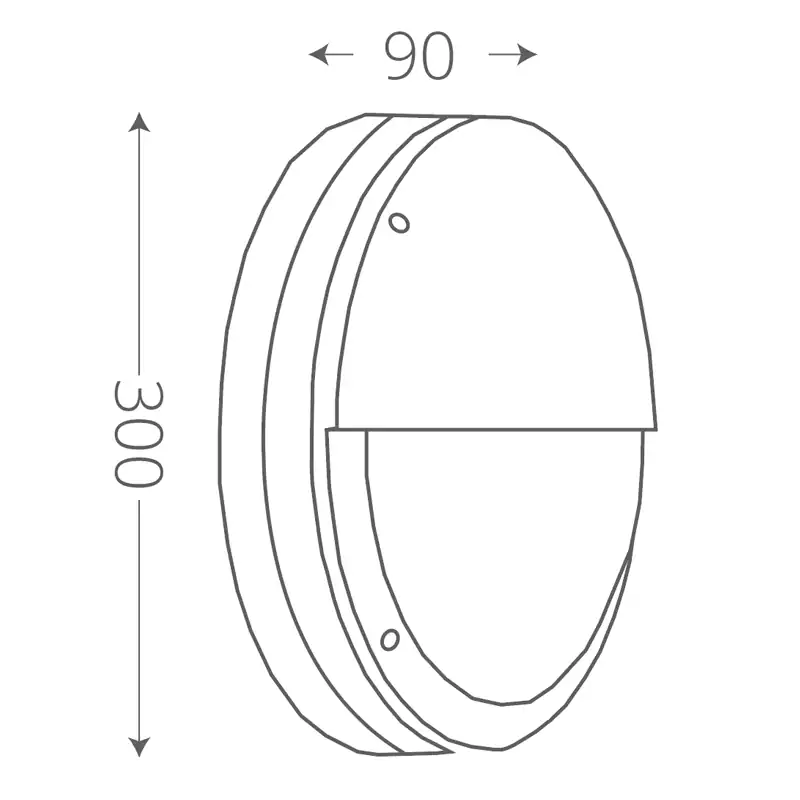
Two types of face covers are available for selection
Both versions share one photometric and electrical specification and the same φ300 × H90 mm envelope. The difference is structural, so selection is made against the drawing at specification stage — optics, CCT and wattage do not change. List both on a tender and mark the required version per zone, so one site keeps one fixture family and one spare-part line.


IP65 sealing for exterior walls
Dust cannot enter the optical chamber and jets of water from any direction stay clear of board and driver. The die-cast housing keeps its sealing groove dimensionally stable through thermal cycling, so the continuous gasket holds compression instead of relaxing. That is what survives wind-driven rain, hose-down cleaning in a car park and salt-laden air on a coastal facade.


IK10 cover for stairwells and car parks
The milky white polycarbonate cover is rated IK10 — a 5 kg hammer strike from 40 cm, the highest standard impact class for luminaires. It deforms and recovers where glass shatters, so a hit never opens the optical chamber to dust and water. At 2.2 m in a stairwell or service passage, that is the rating that decides whether the fixture is still there in year five.
Die-cast housing and heat path
12 W or 24 W sits inside a φ300 mm body with fins cast into the back shell. Heat leaves the LED board through metal instead of sitting behind a plastic back plate, so junction temperature stays lower and lumen depreciation slows across the 50,000-hour rating. The same casting holds its shape on rendered walls that are never perfectly flat — where pressed steel opens a gasket gap.


120 lm/W and what it buys on a wall
The 12 W version delivers roughly 1,440 lm, the 24 W version roughly 2,880 lm, both from a 90 mm deep body. On a corridor wall at 2.4–3 m that holds a usable level without stacking fixtures every two metres — and installation, not the fixture, is where the budget goes. Compare lumens and wattage together, never wattage alone.
Dims when the room is empty.
GS-R300 can be supplied with a built-in motion sensor. Walk into range and the fixture comes on at full output; when the area is clear again it goes off, or drops to a lower holding level, after a set delay.
The sensor reads movement in front of the fitting — body heat (PIR) or microwave reflection, depending on the module — which is what makes the version worth specifying on corridor walls, stair cores, car park ramps and service passages, where the light has to be there but people are not.

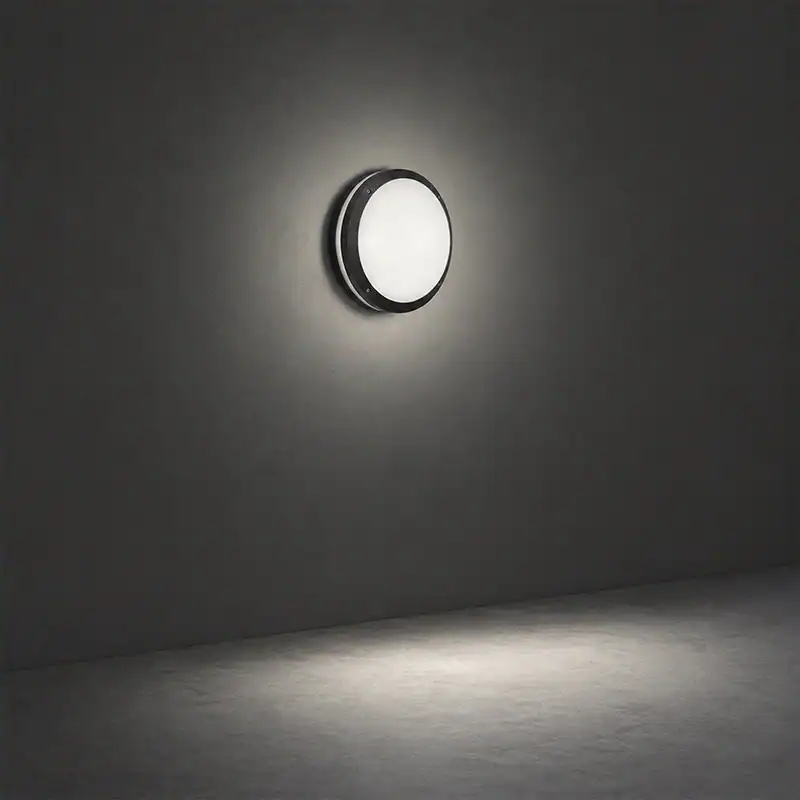
120° beam and how far apart they go
Distribution is 120° — wide and symmetric, spreading along the wall rather than punching a bright circle at the lens. On a 2.4–3 m corridor wall, 4–5 m between fixtures holds continuous coverage at floor level; on a 3.5–4 m car park wall, 5–6 m. It also mounts lower than a narrow-beam downlight without leaving a hot spot on the wall.
Drawing data you can lay out from
IES / LDT files and the installation drawing ship inside the datasheet pack. Drop-in replacement: the body is φ300 × H90 mm, the footprint most round bulkheads on corridors already use — swap without re-drilling, moving the conduit entry or touching the circuit.

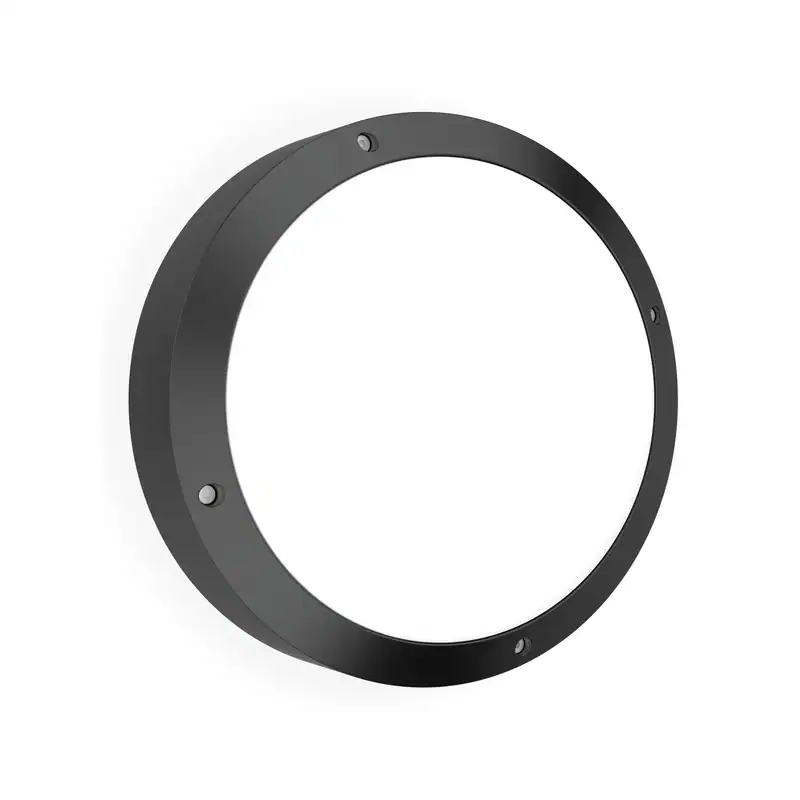
custom RAL
Ring, bezel and back shell are finished as one component, so the colour holds across the whole fixture and not only on the visible face. Custom RAL is quoted per project — MOQ and lead time are confirmed before the order is placed.
A deliberate line against light stone and rendered facades — chosen when the fixture should be seen.
Disappears into painted ceilings and plaster walls — the residential corridor default.
Sits against concrete, galvanised steel and most industrial wall finishes.
Matched to facade, joinery or a landscape palette — send the RAL code and we confirm feasibility and MOQ.
Specifications
What you get after the order
5-year warranty
Covers the driver and LED module under normal operating conditions. Replacement parts are shipped from our factory, not from a local distributor.
Engineering support
Specification review before you order: we confirm the model, size, CCT and options against the installation condition and return a matching datasheet.
OEM / ODM
Certifications About LED Bulkhead Light

- Certifieate No. POCE220728128HCE
- Certification body: SHENZHEN POCE TECHNOLOGY CO., LTD.

- Certifieate No. POCE220728129PCS
- Certification body: SHENZHEN POCE TECHNOLOGY CO., LTD.
Where This LED Bulkhead Light Fits
Corridors, stair cores, car park walls, villa exteriors, warehouse perimeters. Not for high ceilings, long-throw facade washing, or where a narrow beam has to reach a specific surface — those need a different optical family.



Questions buyers actually ask
They go wherever a fixture is mounted directly on a wall and has to survive weather and people — apartment and hotel corridors, stair cores, service passages, car park walls and ramps, villa exteriors and boundary walls, school and hospital circulation areas, and warehouse perimeter walls. The common thread is a wall surface at 2–3m, seen from close range, with cleaning and impact risk. A bulkhead light is the wrong choice on high ceilings or for long-throw facade washing; those need a different optical family.
Yes. The body is Ø300 × H90mm, the footprint most existing round bulkheads on corridors and service areas already use, so a refurbishment does not need new drilling, new conduit entries or circuit changes. Because the driver and terminal block sit inside the 90mm depth, the fixture mounts flush without a spacer ring. For phased work in an occupied building, that means one visit per point instead of a re-fit.
That is the environment it was specified for. IP65 keeps dust out of the optical chamber and stops water jets reaching the LED board and driver, and the die-cast aluminium body holds its sealing groove through years of thermal cycling, so the gasket keeps compression instead of relaxing. GS LIGHT tests housings in salt spray and temperature-humidity chambers before release. The practical marker is the gasket, not the IP number: a pressed-steel housing deforms on an uneven wall and the seal fails first.
Polycarbonate with UV stabilization is the standard material for exterior diffusers; it resists yellowing far better than unstabilized acrylic and does not shatter like glass. Impact resistance is IK10, equivalent to a 5kg hammer strike from 40cm, so a trolley or ladder hit deforms the cover without opening the chamber. For dusty sites, wipe with water and a soft cloth — abrasives and solvents dull the surface and reduce light output over time.
Match it to mounting height and spacing. At 120lm/W, 12W gives roughly 1,440lm and 24W roughly 2,880lm. On a 2.4–3m corridor wall with 4–5m spacing, 12W is normally sufficient; on 3.5–4m car park walls, higher mounting or wider spacing, 24W keeps the light level without adding fixture count. Send the layout and we will run the spacing for the LED bulkhead light against your target illuminance.
No. The ring and the centre diffuser are fed from the same optical assembly and the same driver, so the fixture works as one light source with one switched live. This is deliberate: it keeps the surface at uniform brightness and avoids the dark rim that appears when a decorative ring is driven separately at a different output.
Use 3000K where the light falls on stone, timber or painted plaster and has to feel warm — hotel corridors, villa exteriors, hospitality walls. Use 4000K for reception, service corridors and mixed-use facades. Use 5000K and 6000K for car parks, warehouses, security lighting and exterior walls in high-ambient regions such as the Gulf, where a cooler source reads as "on" in daylight. Because one housing family covers all four, a project can change CCT late without changing the fixture.
With a 120° beam and wall mounting at 2.4–3m, spacing of roughly 4–5m between fixtures gives continuous coverage at floor level; on 3.5–4m car park walls it extends to about 5–6m. Because the beam is wide and symmetric, the fixture can sit lower than a narrow-beam downlight without a hot spot on the wall. Treat these as starting points and verify against the photometric file for the actual corridor width.

