GS Light logo

Retail Lighting

Retail lighting combines ambient, accent and task light so merchandise is shown in good color, displays stand out and shoppers can find their way, with each layer chosen for the goods and the store.

Find retail lighting built for true color rendering and energy efficiency.
GS retail lighting solution

High CRI for True Colors

Color rendering index (CRI) measures how closely a light source renders a set of test colors compared with a reference illuminant of the same color temperature. LED retail fixtures with CRI above 90 render fabrics, jewelry and food well, but a high score does not guarantee the exact appearance of every material. For red goods such as fresh meat, cosmetics and fashion, ask for the R9 value and color consistency data too, and check a sample on the merchandise.
led-lights-downlights-back-b

Lower Energy Costs

LED retail lighting typically uses about half the energy of fluorescent fixtures and up to 80% less than halogen spotlights when it delivers the same light on the merchandise. The fixtures also add less heat to the space, which can reduce cooling load depending on the store and the season.
high-bay-2

Flexible Light Control

Depending on the model, LED fixtures dim on 0 to 10V, Triac or DALI for brightness control in each zone. Track lights with interchangeable lenses or zoom versions direct light where products need attention; confirm the lowest stable dimming level and flicker for the configuration quoted.
CCT-Adjustable-Track-Light-–-TD-Series (1)-b

Aesthetics and Practicality

Linear lights join in straight runs and in Y, T, L and cross shapes, so a ceiling pattern can follow the floor plan and lead shoppers along the main aisle. Storefronts and mall exteriors are a layer of their own, planned with the same care as the building facade lighting of an office or hotel.
led Linear light retail lighting solution

Select the Proper Retail Lighting System

Retail stores use three main lighting system types. Your choice depends on ceiling height, store layout, operating hours, and how accurately you need to display product colors.

Whichever source you choose, plan the store in three layers: ambient light for the whole floor, accent light on displays, and task light at tills and fitting rooms. The layers overlap: a track head can wash a wall as well as accent a display, and downlights do not automatically give even light on shelves. In Europe, EN 12464-1:2021 gives starting values of about 300 lux on sales floors and 500 lux at tills; North American stores usually follow IES RP-2, and many retailers set their own store standard. Confirm the levels with the brand's standard and a photometric calculation, as on our commercial lighting projects.

High Intensity Discharge (HID) Lamps

HID lamps generate light by passing current between two electrodes with ionized gas inside a bulb. Types include sodium, mercury, and metal halide lamps.

Pros

Lower upfront cost than LED lighting
More energy efficient than halogen lamps

Cons

Bright point source that makes glare hard to control
Warm up and restrike delays of several minutes, depending on the lamp and gear
Poor compatibility with dimming controls
CRI from about 20 (high pressure sodium) to 65 to 90 (metal halide), and color shifts as lamps age

Fluorescent Lighting

Fluorescent lamps generate ultraviolet light in mercury vapor, which a phosphor coating on the tube converts into visible light.

Pros

Wide color temperature range (2700K to 6500K)
Lower heat output than HID

Cons

Dimming needs dedicated dimming ballasts
Contains mercury requiring professional disposal
CRI typically 70 to 85, limiting color accuracy
cob led track light

LED Lighting

LED lighting generates light in a semiconductor chip, usually with a phosphor that sets its color. This technology dominates modern retail lighting design.

Pros

High efficacy, about 95 to 160 lumens per watt across GS LIGHT's retail fixtures depending on the model
Works with dimming and control systems through compatible drivers
Rated life stated on each model's datasheet, with its test conditions
CRI options from 80 to 95 depending on the model
Various fixture designs for different retail applications

Cons

Higher upfront cost than HID or fluorescent; running cost savings depend on hours, tariff and the system replaced

Types of Retail Store Lighting Fixtures

Based on the comparison above, LED is the practical choice for new stores and refits. Track lights usually carry the accent layer, recessed downlights the general light and wall displays, LED panels the ambient light in grid ceilings, and linear lights the aisles and architectural lines, but the optic, output and aiming decide which layer a fixture serves. Most stores combine at least two.
cob-led-track-light-b

LED Track Lights

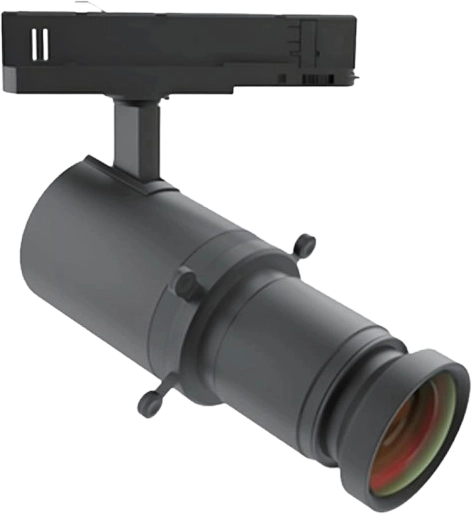
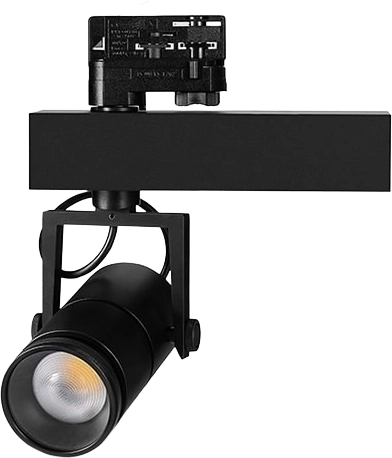
Track lights mount to ceiling rails and can be repositioned as merchandise displays change, on a rail and adapters that match the fixture. GS LIGHT's TZ Series offers interchangeable lenses from 12° to 65° and a 10° to 60° zoom version, CRI above 90 (95 available) and CITIZEN, CREE or OSRAM LEDs, in 20W and 30W with 0 to 10V, Triac or DALI dimming by configuration.

As an illustrative starting point, a feature display lit at about 3 times the surrounding light level draws the eye, and 5 to 10 times reads as a hero piece; the surface's reflectance, the background and the viewing direction change how strong it looks. For the CHANEL jewelry exhibition at Marina Bay Sands, Singapore, GS LIGHT supplied CRI 95+ track lights with 2.4G wireless dimming for the 2023, 2024 and 2025 shows.

Pros

Repositionable fixtures for changing displays
Interchangeable lenses or zoom versions for accent lighting
High CRI (90+) for accurate product colors
Multiple lens options without replacing fixtures
Warranty under GS LIGHT's written warranty terms

Cons

Visible track rail may not suit all store aesthetics

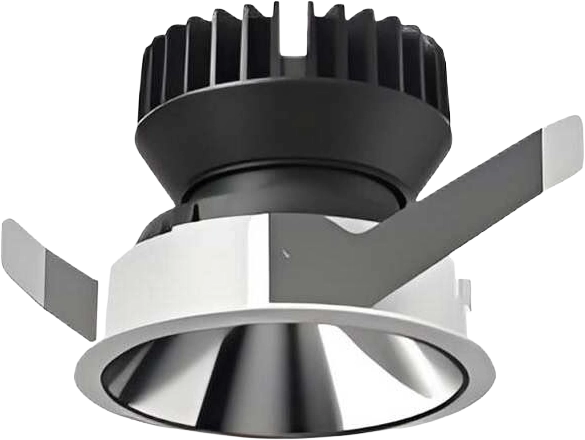
Recessed LED Downlights

Recessed downlights install flush with the ceiling for clean, minimalist appearance. The PL Series has a super narrow bezel, 30° tilt adjustment for switching between display lighting and wall washing, and Bridgelux, OSRAM or CREE COB light sources. Beam angles range from 10° to 50° with wattages from 6W to 25W at 100 lumens per watt, and the fittings suit 75 to 95 mm ceiling cutouts.

The wider down lights range adds square, adjustable and IP65 models for entrances, washrooms and back of house areas.

Pros

Clean aesthetic that doesn't compete with merchandise
Adjustable tilt for wall washing and displays
Deep optics for glare control, with UGR below 19 achievable in suitable layouts
Multiple beam angle options
Warranty under GS LIGHT's written warranty terms

Cons

Fixed position once installed
Requires ceiling cutout for installation
Untitled-e
led-panel-lights-120x30-back-lit-light-b

LED Panel Lights

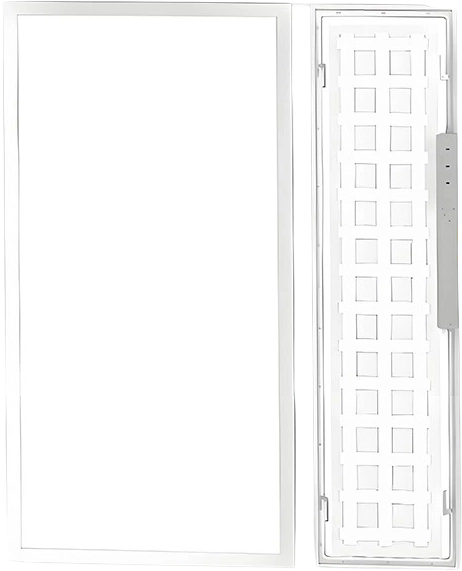
LED panels deliver soft, uniform ambient lighting throughout the store. The 600×600 edge lit panel measures just 10 mm thick and runs at 100 to 130 lumens per watt with CRI above 80, on Philips, Tridonic or Eaglerise drivers depending on the order; ask for the flicker figure of the configuration quoted. Where efficacy matters most, the modular M Series panel reaches 160 lumens per watt. Both dim on 0 to 10V or DALI, and UGR below 19 is achievable in suitable layouts.

Pros

Even light from a diffused surface
Slim profile (10 mm) for low ceiling clearance
Low flicker driver options for long opening hours
High efficiency up to 160 lm/W (M Series)
Fits standard commercial ceiling grids
Warranty under GS LIGHT's written warranty terms

Cons

Fixed light distribution pattern
Less accent capability than track lights

LED Linear Lights

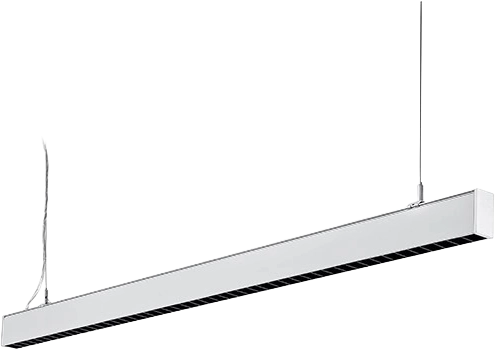
Linear fixtures create architectural lighting effects and work well for aisles and corridors. The L5075 Series uses modular connectors for Y, T, L, and cross configurations. Light efficiency of 120lm/W and CRI above 80 suit general retail lighting throughout the store.

The 20W and 40W modules use OSRAM LEDs in an IK10 rated body, and an emergency battery option is available; escape route lighting is designed and tested as its own system to local rules. Certificate details for the model quoted are on the certifications page.

Pros

Modular design for custom configurations
Continuous runs for aisle lighting
Modern architectural appearance
High efficiency (120 lm/W)
Multiple mounting options
Warranty under GS LIGHT's written warranty terms

Cons

Less focused than track or downlight options
Requires planning for modular layouts
linear-light-b

Features and Benefits of Retail Store Lighting

battery-eco

Lower Running Costs and ROI

Stores that open long hours see LED savings fastest. As an illustrative example: a 24 hour convenience store replaces 40 fluorescent troffers with 40W LED panels, assuming each troffer draws 72W in total input and the panels deliver the same light. The load falls by 1.28 kW (40 × 32W), which over 8,760 hours a year is 11,212.8 kWh, or $1,681.92 a year at $0.15 per kWh. Your figure depends on the measured input of the existing fittings, the opening hours, the tariff and any dimming.

Round the clock retail is a familiar brief for GS LIGHT: our gas station lighting project covered the forecourts and convenience stores of more than 30 SGC Investments filling stations in Zambia in 2020.
timeline-event-text

Improved Customer Experience

Lighting sets the atmosphere customers walk into. Comfortable illumination with a suitable color temperature makes a store pleasant to browse, and harsh or flickering light does the opposite. Common choices are 2700K to 3000K in boutiques, jewelry and fashion stores and 3500K to 4000K in supermarkets and department stores, but color temperature is a design decision for each brand, and showrooms that treat products as exhibits borrow from museum lighting.
vector-bezier-2

Better Product Visibility and Safety

High CRI lighting shows product colors well, and even illumination without dark spots helps customers and staff move safely through the store.

For a supermarket lighting project in Pakistan, GS LIGHT supplied 650 linkable tri proof lights in continuous rows; the project page reports a maximum measured illuminance of 750 lux, which is a peak value, not the average across the sales floor.

Outside the store, GS LIGHT supplied wall washers, linear lights and inground lights on DMX512 control for the exterior of the Sharjah Coop Rahmania Mall in the UAE.

Retail Lighting FAQs

What store owners, fitout contractors and lighting designers ask before they send a floor plan.

There is no fixed density: the count comes from a photometric calculation using each fixture's output and optical file, the mounting height, room reflectances, the maintenance factor and the target levels on the floor, shelves and displays. In Europe, EN 12464-1:2021 gives starting values of about 300 lux on sales floors and 500 lux at tills, while North American stores usually follow IES RP-2 and many brands set their own standard. Accent lights are counted on top, display by display.

Both are possible, but a retrofit lamp or tube changes how the old fixture distributes light, so it needs checking rather than assuming the result stays the same. Confirm electrical and ballast compatibility, the temperature inside the old housing, the optics and the safety listing requirements in your market. Full replacement is usually chosen when the layout is changing or the old fixtures are near the end of their life.

UGR (Unified Glare Rating) estimates discomfort glare from the luminaires in a space, and EN 12464-1 limits it to 22 on sales floors and 19 at tills. It is calculated for the whole layout and viewing positions, so a fixture label cannot guarantee it, and it does not cover reflections from glossy goods, glass or screens. Deep optics, low brightness diffusers and careful aiming help on all of these.

Window displays need more light by day than by night, because daylight on and through the glass washes out weaker lighting. As an illustrative starting point, daytime schemes often light the display at 3 to 5 times the store's ambient level, using adjustable track lights or spots aimed from above, and dim after dark. Glass reflections depend on the sun, the street and the viewing angle, so test the aiming from the street.

Ask for the certificate that covers the exact model and configuration quoted, issued for the market where the store will open. GS LIGHT's certifications page lists CE (EMC and LVD) and RoHS documents for selected lines and ISO 9001 and ISO 14001 for its management systems, which are not product performance certificates. For North American stores, ask whether UL or ETL listing is available for the model before you specify it.

Send Your Inquiry

Ready to Start Your Lighting Project?
From architectural lighting solutions to OEM/ODM customization, GS LIGHT helps global partners create reliable LED lighting solutions.
Copyright 2026 GS LIGHT. All Rights Reserved.
Privacy Policy
Terms & Conditions
Sitemap

Send Your Inquiry

gslight-wechat-qr