GS Light logo

Sports Field Lighting

Find LED sports field lighting built for visibility, durability, and energy savings.
sports-field

Energy Efficiency

LED sports lights use 50-75% less energy than metal halide fixtures. For a facility running lights 4-6 hours per night, that translates to thousands saved annually on electricity bills alone.
Untitled (2)

Instant Control

No more waiting 15-20 minutes for lights to warm up. LED field lights turn on instantly at full brightness, and you can dim them for training sessions or different event types without affecting lifespan.
Untitled (3)

Broadcast Ready

High CRI ratings (80-90+) and flicker-free operation mean your venue is ready for HD and 4K camera coverage. Players and spectators see true colors, and broadcast footage stays sharp during slow-motion replays.
Untitled

Built to Last

IP67 waterproof ratings handle heavy rain and humidity. IK10 impact resistance protects against accidental hits. And with 50,000+ hour lifespans, you won't be scheduling bulb replacements for over a decade.
Untitled (1)

Select the Proper Sports Field Lighting System

Three main lighting technologies are used in sports facilities today. The right choice depends on your energy budget, maintenance capacity, and whether your venue hosts televised events.

Metal Halide Lamps

Metal halide lamps create light by passing electricity through a gas mixture inside a bulb. They've been the standard for stadium lighting since the 1960s.

Pros

Lower upfront purchase cost than LED
Familiar technology for most maintenance teams

Cons

Takes 15-20 minutes to reach full brightness
Must cool completely before relighting (restrike delay)
Creates uneven light with hot spots and dark areas
Shorter lifespan of 6,000-15,000 hours
Light quality degrades and shifts color over time
High energy consumption
Contains mercury, requiring special disposal
Poor dimming capability

High-Pressure Sodium (HPS) Lamps

HPS lamps are more efficient than metal halide but produce an orange-yellow light that distorts colors.

Pros

More energy efficient than metal halide
Longer lifespan than metal halide

Cons

Poor color rendering makes everything look orange
Not suitable for sports where players need to see accurate colors
Same warm-up and restrike delays as metal halide
Limited dimming options
SL

LED Lighting

LED sports lights generate light by passing current through semiconductors. They're now the standard for new installations and retrofits.

Pros

50-75% lower energy consumption than metal halide
Instant on/off with no warm-up time
Excellent light uniformity across the field
50,000+ hour lifespan (roughly 11 years at 12 hours daily use)
High CRI (80-90+) for accurate color rendering
Flicker-free for broadcast cameras
Works well with dimming and smart controls
Functions in temperatures from -30°C to +55°C
No mercury or hazardous materials
Multiple beam angles for precise light placement
Lower long-term maintenance costs

Cons

Higher upfront cost (typically offset by energy savings within 2-4 years)

Types of Sports Field Lighting Fixtures

Based on the comparison above, LED lights are the clear choice for sports field lighting. GS Light offers several fixture series designed for different venue sizes and competition levels.
Untitled (4)-b

High-Power Stadium Lights (1000W-1500W)

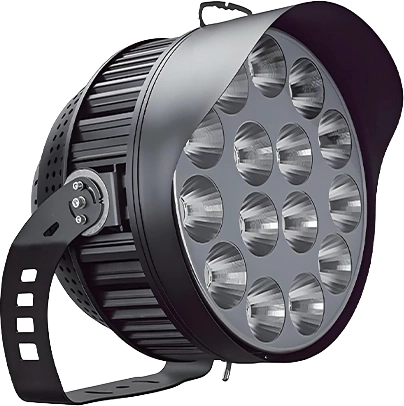
These fixtures are built for full-size football and soccer fields, professional stadiums, and venues hosting televised events. The RG Series LED Sports Lighting delivers up to 170lm/W efficiency with IP67 waterproofing and 10kV lightning protection.

Specs:

Wattage options: 500W, 600W, 1000W, 1200W, 1500W
Beam angles: 8° to 60°
Dimming: 1-10V, PWM, DALI, DMX512
Protection: IP67 waterproof, IK10 impact resistant

Best for:

Professional football/soccer fields, regional stadiums, broadcast venues

Medium-Power Sports Lights (500W-750W)

The RC Series Soccer Field Lights uses CITIZEN COB LEDs with CRI options of 80 or 90 for superior color accuracy. The modular design means if one component fails, you replace just that module instead of the whole fixture.

Specs:

Wattage options: 500W, 600W, 750W, 1000W, 1200W, 1500W
Efficiency: 130lm/W
Beam angles: 15° to 60°
Protection: IP65 waterproof

Best for:

Tennis courts, basketball courts, training fields, recreational facilities, multi-purpose venues
Untitled
Untitled-c

High Mast Stadium Lighting (400W-800W)

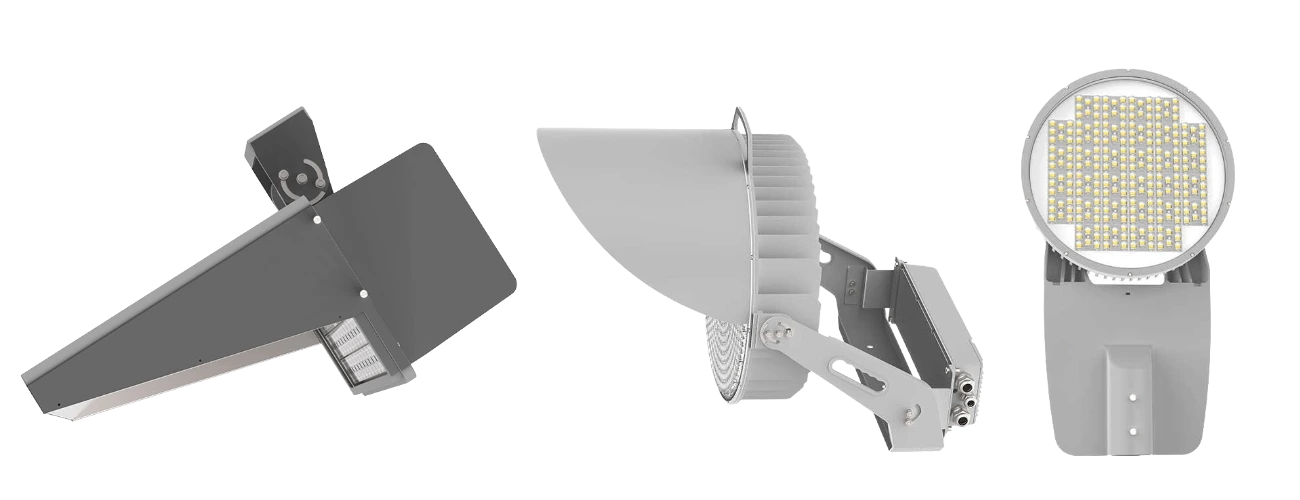
For venues with tall poles (25-40 meters), the SP Series High Mast Stadium Lighting provides the narrow beam angles needed to project light accurately over long distances while maintaining uniformity across the playing surface.

Best for:

Large professional stadiums, airports, ports, international competition venues

Indoor Gymnasium Lighting

For indoor basketball courts, volleyball gyms, and multi-sport facilities, LED High Bay Lights provide the high-output, glare-controlled illumination needed for indoor play. Look for fixtures with anti-glare optics since gymnasium floors are typically reflective.

Best for:

School gyms, recreation centers, indoor sports halls, basketball and volleyball courts
Untitled-d

Features and Benefits of
Warehouse Lighting

battery-eco

Energy Saving and Cost Reduction

LED sports lighting systems cut energy consumption by 50-75% compared to traditional metal halide installations. A typical stadium retrofit pays for itself in 2-4 years through electricity savings alone. Add smart controls with occupancy sensors and scheduling, and you can reduce consumption by another 30-40%.
timeline-event-text

Improved Player Performance and Safety

Uniform lighting eliminates the shadows and dark spots that can cause players to lose track of fast-moving balls. High CRI values (80-90+) ensure accurate color perception, which matters for team sports where players need to quickly identify teammates and opponents. Better visibility also reduces the risk of collisions and injuries during play.
vector-bezier-2

Better Spectator Experience

Proper sports lighting keeps spectators engaged. Bright, even illumination across the field means fans in every seat get a clear view of the action. For venues hosting evening events, quality lighting creates an atmosphere that makes the experience memorable.

Sports Field Lighting FAQs

Most frequent questions and answers

A standard football field (105m x 68m) typically requires 16-24 LED fixtures at 1000W-1500W each, mounted on 4-8 poles. Exact quantity depends on target lux levels, pole height, and beam angles. Recreational fields need fewer fixtures than broadcast venues requiring 1500+ lux uniformity.

Sports field lighting poles should be 15-25 meters for recreational fields and 25-40 meters for professional stadiums. Taller poles reduce glare and improve uniformity but require narrower beam angles. FIFA recommends minimum 25-degree mounting angles from the field perimeter to ensure proper player face illumination.

LED sports field lighting costs $50,000-$300,000 depending on field size, competition level, and existing infrastructure. A recreational field retrofit runs $50,000-$80,000, while broadcast-ready professional installations reach $150,000-$300,000. Energy savings of 50-75% typically deliver ROI within 2-4 years.

LED sports lights can retrofit onto existing metal halide poles in most cases. Check pole structural capacity since LED fixtures are often lighter than metal halide equivalents. Existing wiring typically works, though electrical panels may need upgrades for smart controls. Mounting brackets are usually interchangeable.

LED sports field lights require minimal maintenance compared to metal halide. Clean lenses annually to remove dirt and debris. Inspect mounting hardware and electrical connections yearly. No bulb replacements needed for 50,000+ hours. Modular designs allow single component replacement if failures occur.

Send Your Inquiry

Ready to Start Your Lighting Project?
From architectural lighting solutions to OEM/ODM customization, GS LIGHT helps global partners create reliable LED lighting solutions.
Copyright 2026 GS LIGHT. All Rights Reserved.
Privacy Policy
Terms & Conditions
Sitemap

Send Your Inquiry

gslight-wechat-qr