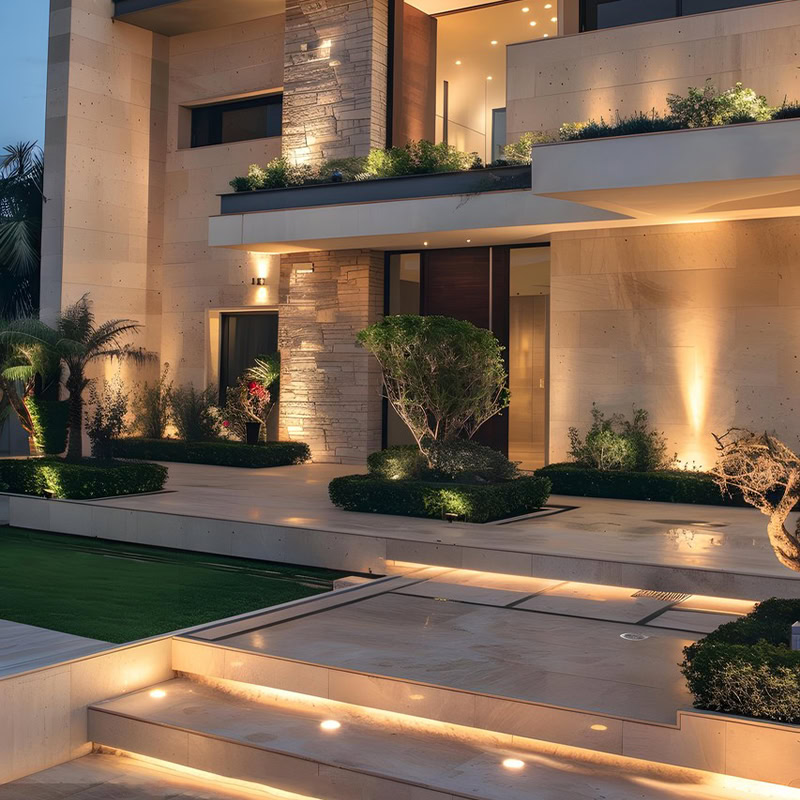
Core Needs: Welcoming ambiance for guests, safe path guidance, highlighting decorative focal points.
Inground Lights: The main body of the lamp is completely embedded in the ground, almost "invisible" during the day, without spoiling the daytime aesthetics of the entrance building and landscape.
Wall Lights: Sleek outdoor fixtures, with IP65 versions available and 3000K warm white a common choice for entrances. Mounted on entry pillars or gate walls, they make the entrance easy to find and bring out architectural details like stonework or wood paneling.
Why We Recommend This: Inground lights keep the entry path safe and visually clean (no cluttered fixtures), while wall lights reinforce the entrance's identity and add a welcoming glow: the upward beam outlines the wall while the downward beam lights the walkway. Together, they balance function and style for an elegant, secure first impression.
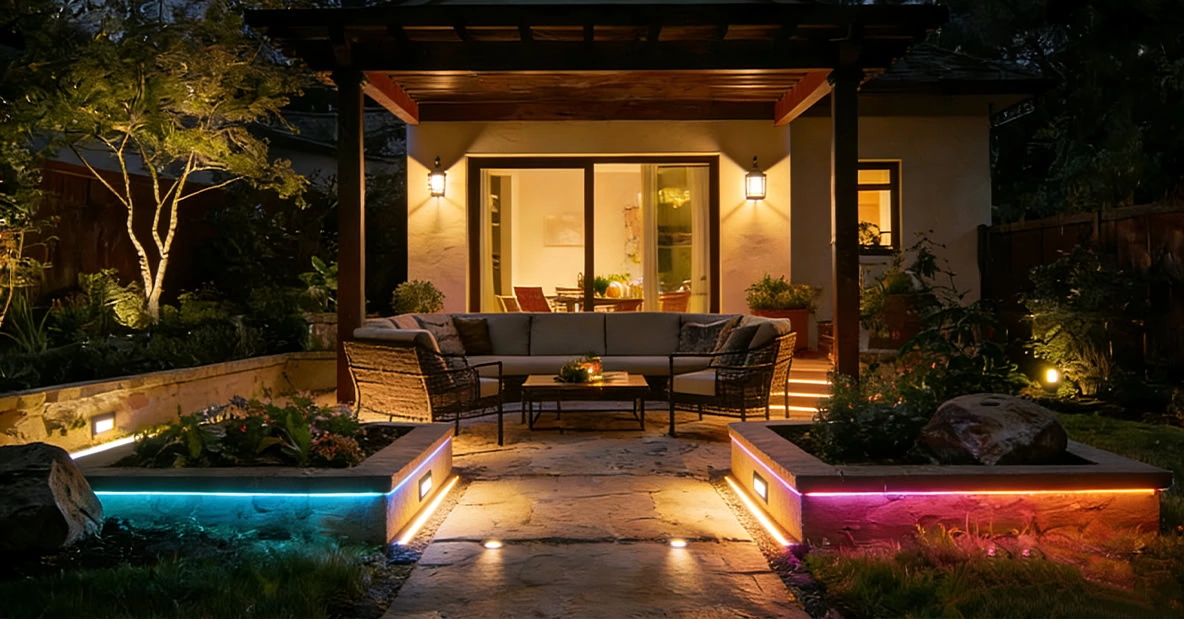
Core Needs: Multi-scene flexibility (gatherings/meals), cozy ambiance, task-focused illumination.
Flexible strip lights: Low voltage strips in single color, RGB or RGBW versions create festive or relaxed atmospheres for patio seating. Each version needs its matching controller.
Dimmable LED Wall Lights: dimming adapts the light to dining, conversation or quiet relaxation; the dimming range and the compatible driver or controller are confirmed for the model quoted.
Why We Recommend This: Flexible strip lights follow curves and install out of sight, and they are cut only at their marked cut points and resealed as the instructions describe. Sealed LED wall lights give steady, dimmable light for outdoor seating. Resort and hotel courtyards use the same pairing, planned together with the pool and terrace on our hotel lighting page.
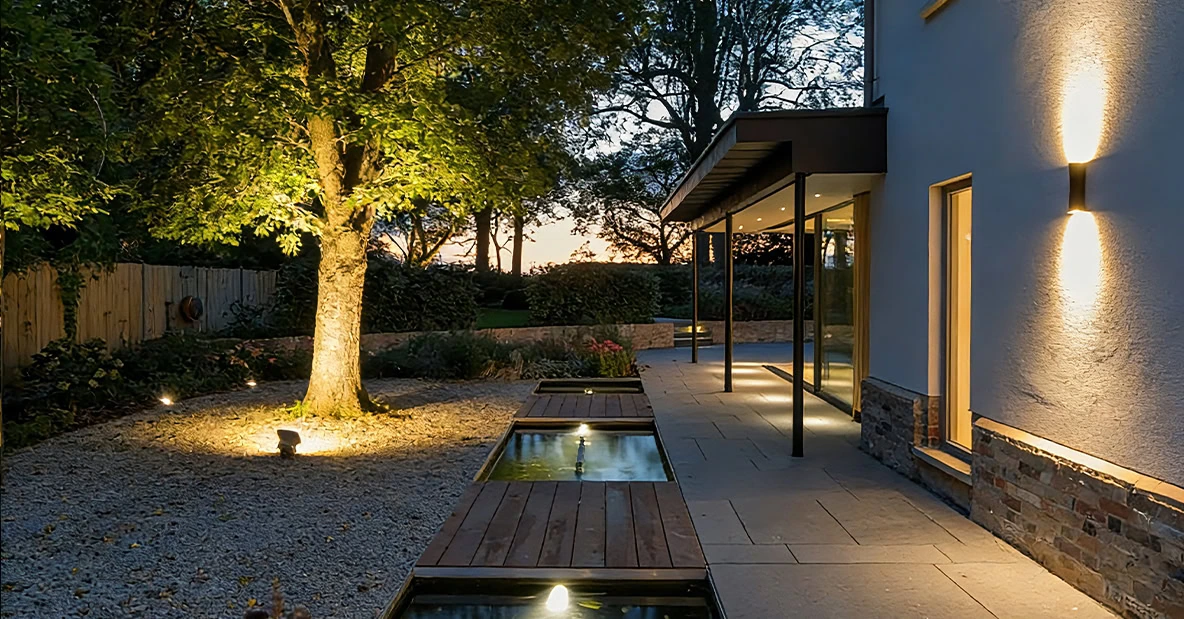
Core Needs: Highlight landscape layers, preserve aesthetics, avoid light pollution.
Garden spike lights: The flexible finishing touch for garden lighting. They can be moved and re-aimed as the planting grows, easily illuminating the focus of the landscape, with mains, low voltage and solar versions depending on the model.
Flood landscape lights: With a wide beam and high output, they cover large areas of planting evenly and create layers of light and shadow, with dimming and glare control accessories available on selected models.
Why We Recommend This: Spike lights provide the flexibility to highlight precise focal points, while flood lights ensure uniform, wide-area illumination that shapes the overall layers of a space. Uplights and floods are aimed into the planting, shielded where they could be seen from windows or seats, and switched off or dimmed late at night, which keeps the light where it is wanted and limits light pollution.
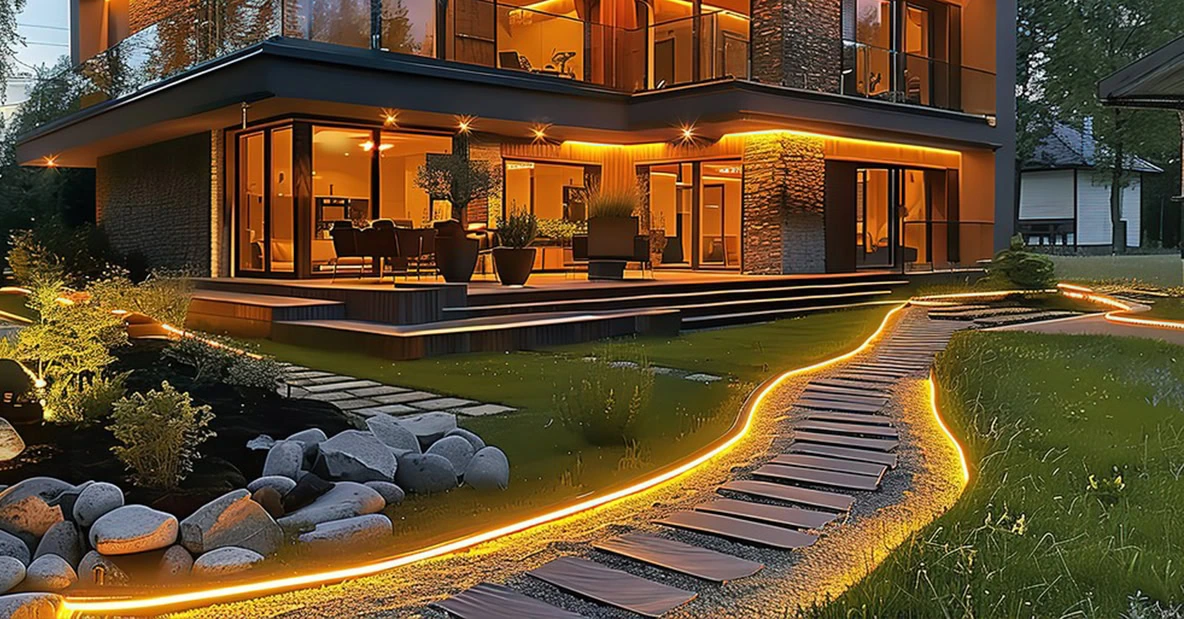
Core Needs: Under the premise of ensuring walking safety and clear guidance, create a comfortable and beautiful night atmosphere.
Post top lights: Mains powered post tops run from 30W to 100W at up to 130 lumens per watt with IP66 and IK09 protection, and a solar series (20W to 40W) charges by day and switches on at dusk where cabling is not practical.
Neon light strips: Continuous linear light gives walkways a decorative, modern line that goes beyond basic lighting.
Inground Lights: Rated IP67, they are protected against dust and against temporary immersion under the test conditions. Where rain can collect, they need a drainage bed under the fixture, a sealed cable connection and the installation sleeve, fitted as the instructions describe. Pools and fountains need fixtures made and rated for underwater use.
Why We Recommend This: LED neon lights are used for creative decoration and atmosphere in courtyards, and post top lights are recommended for large scale, energy saving base lighting. The two can be combined to achieve a combination of function and aesthetics.
Path light levels for a private courtyard are set by the project brief and any local rules; EN 13201 covers public roads and paths, not private courtyards. Bollard spacing comes from the bollard's photometric file and the path's width, surface and target light level, so it is set in the calculation rather than by a fixed rule. Our bollard lights come in single sided and double sided versions for paths lit from one side or both.
| Zone | Lighting task | Fixture family | Optical consideration | Installation constraint |
|---|---|---|---|---|
| Entrance | Find the door, light steps and faces | Wall lights, inground lights | Up and down beams on walls; narrow beams from the ground | Wall mounting surface; drainage under inground lights |
| Leisure | Comfortable light for seating and dining | Dimmable wall lights, flexible strips | Low glare toward seated eye height | Dimming driver or controller per model; strip cut points and driver access |
| Greenery | Reveal trees and planting | Spike lights, landscape floods | Beam width matched to the plant; shielding toward windows | Cable or solar route; re-aiming as plants grow |
| Pathway | Safe walking and orientation | Bollards, post tops, inground lights | Light on the path, little light above the horizontal | Spacing from the photometric file; mains or solar supply |
| Features and walls | Accent on facades, sculpture, water features | Wall washers, inground lights, spike lights | Grazing or washing angle set to the surface | Fixtures near water rated and installed for that use |
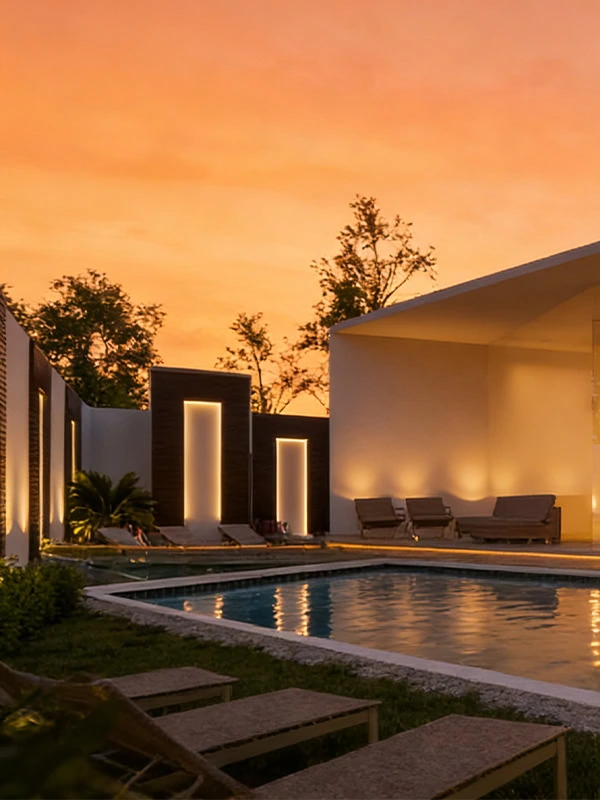
The right courtyard lighting makes your outdoor area a warm, inviting and fully usable extension of the building after sunset. Each lighting category serves a distinct purpose. Here is a breakdown of the key options:
As the most "original" lighting method, natural light not only illuminates the courtyard for free but also adds to the space's transparency and comfort. Sunlight spilling over plants, patios, or water features naturally creates a relaxing atmosphere, making the courtyard more lively.
Artificial lighting is the core light source for courtyards at night. It is further divided into 3 types based on functional differences:
1. Ambient Lighting
Purpose: To provide soft, uniform base illumination that establishes a warm overall atmosphere for the courtyard lighting scheme, ensuring the space is comfortably lit and never overly dark.
2. Task Lighting
Purpose: To deliver focused, brighter light to specific zones, addressing practical needs and ensuring safety and convenience for activities within the courtyard lighting plan.
3. Accent Lighting
Purpose: To artistically highlight key architectural features or landscape elements, using light to direct visual interest and bring out the depth and appeal of the courtyard lighting design.
• Lumens: as rough product outputs, 100 to 300 lumens suit ambient lighting, 300 to 800 lumens accent lighting and 800 to 5000 lumens task and safety lighting. Lumens describe what a fixture emits, not the light that lands on a path or wall; the optics, mounting height and aiming decide that, so larger and commercial courtyards are planned by the light on each surface in a calculation.
• CCT: 2700K to 3000K (warm white) is the usual default for courtyards, especially near bedrooms, wildlife habitat and quiet seating; 4000K to 5000K (cool white) suits functional areas where the project calls for it, and RGB options support color scenes. Keeping one color temperature across a view gives a calm result, though a designer may vary it on purpose.
• Evaluate your courtyard's size, layout, and key zones (e.g., lawns, patios, water features) to determine the required lighting types and quantities.
• Select lighting based on specific use cases: for example, pair dimmable accent lights with leisure areas and use brighter task lights for dining zones. Where motion sensors are used, set them so paths never go fully dark and lights do not switch on and off with passing movement.
• Consider installation complexity: solar courtyard lighting avoids trenching for mains cable, but it still needs mounting and internal wiring, while mains and low voltage products are installed by a qualified electrician to local rules.
• Choose low maintenance products (e.g., sealed enclosures, accessible drivers, replaceable batteries) and plan access to drainage and cable connections for inspection.
• Choose courtyard lighting products with at least IP65 for exposed areas to withstand rain, snow and humidity. IP67 adds protection against temporary immersion under the test conditions; continuous submersion in pools or fountains needs fixtures made and rated for underwater use.
• The IP rating covers dust and water only. Corrosion, UV exposure, load from foot or vehicle traffic over inground lights and the lens surface temperature each need their own check; on coastal or pool side sites, ask for the coating system, gasket material and stainless fixings of the model quoted.
• Check the rated life on each model's datasheet, together with its test conditions, to plan replacement and maintenance.
• LED fixtures can use up to 80% less energy than incandescent and halogen lamps delivering the same light, which reduces electricity costs.


Inground Light

Landscape Flood Light

Solar Garden Light
Light a courtyard in layers: inground or bollard lights for safe paths, dimmable strip lights for a cozy ambiance in seating zones, uplights on trees and features, and up and down wall lights on exterior walls for architectural depth. Start from a warm color temperature, aim and shield each fixture so it cannot be seen from the windows that overlook the space, and dim or switch off accent light late at night.
IP65 is a common minimum for exposed areas, and IP67 adds protection against temporary immersion under the test conditions. Neither makes a fixture suitable for continuous submersion: pools and fountains need fixtures made and rated for underwater use, installed to local electrical rules. Inground lights also need drainage underneath, and coastal sites need the right coating and fixings, because IP covers dust and water, not corrosion.
Install adjustable uplights or spotlights on focal points such as trees and sculptures; as an illustrative starting point, about 2 to 3 times the surrounding light level reads as clear emphasis. The visible effect also depends on the surface's reflectance, the beam, the viewing angle and the surrounding light, so narrow beams suit slender trees and statues, wider beams suit broad canopies, and the final aim is set on site after dark.
Solar suits low wattage fixtures such as garden and post top lights on sunny, unshaded sites, while hardwired systems suit higher output fixtures such as wall lights and floods. Solar autonomy depends on the battery's usable capacity, the load and dimming profile, temperature and the site's winter sun, so ask for the sizing for the model and site. Solar avoids mains trenching but still needs mounting and internal wiring.
Send the courtyard plan, the zones you want to light and any coastal or pool exposure. We reply with suitable fixtures for each zone and a product quotation.